King John Inviato 30 Dicembre, 2017 Autore #1326 Inviato 30 Dicembre, 2017 Ptolemaic kings of Egypt, Tetradrachm,Alexandria, Ptolemy I Soter (305-282), c. 310-305 BC, AR, (g 15,66, mm 27, h 12). Deificated head of Alexander r., wearing elephant-skin, Rv. AΛEΞANΔPOY, Athena Alkidemos advancing r., holding spear, shield and aegis; at r. ΓH and eagle. SNG Copenhagen 15 ff.Old cabinet tone. about extremely fine.The tetradrachm shows, on obverse, the deified head of Alexander III with some symbols: horns of Zeus Ammon, elephant-skin, the diadem and aegis. The horns of Ammon were given to Alexander because he went to Ammon’s oracle in oasis of Siwa, like Perseos and Herakles. The others elements were attributed not only to Alexander. The aegis, for example, was attributed, by Ptolemy I, in 314 BC, for celebrating the displacement of Capital of kingdom of Egypt from Memfis to Alexandria. According ancient authors, Ptolemy uses, on his monetization, the deified head of Alexander as funeral sign for the death of Alexander IV, Alexander’s son, killed by Cassander in 310 BC. On reverse, instead, of Zeus enthroned, Ptolemy prefers Athena Promachos holding shield for protecting eagle, symbol of Ptolemaic dinasty. ILLUSTRAZIONE: ALESSANDRO IL GRANDE NEL TEMPIO DEL DIO AMMONE NELL'OASI DI SIWA. Cita Awards
King John Inviato 2 Gennaio, 2018 Autore #1327 Inviato 2 Gennaio, 2018 PAMPHYLIA, Aspendos. Circa 465-430 BC. AR Stater (18.5mm, 10.93 g, 11h). Warrior, holding short sword and shield, advancing right; uncertain object between legs / Triskeles; to lower left, cock standing left; palm frond to right; all within incuse square. SNG France 11 (same dies). Good VF, toned, struck with worn obverse die. Rare. From the Friend of a Scholar Collection, purchased from Maison Platt, April 1987. Cita Awards
King John Inviato 3 Gennaio, 2018 Autore #1328 Inviato 3 Gennaio, 2018 Ptolemaic kings of Egypt, Ptolemy XIII (80-51), Tetradrachm, Alexandria, c. 72 BC, Ag (g 14,49 mm 24 h 12), Diademed head of Ptolemy r., wearing aegis, Rv. BAΣIΛEOΣ ΠTOΛEMAIOY, eagle, closed wings, with closed wings, standing on winged thunderbolt l. at l., LΘ and Isis headdress, at r., ΠA. Svoronos 1823 SNG Copenhagen 403. Cabinet tone. Good very fine. ILLUSTRAZIONE: LA BATTAGLIA DEL NILO COMBATTUTA TRA GIULIO CESARE E TOLOMEO XIII NEL 47 A.C. Cita Awards
King John Inviato 6 Gennaio, 2018 Autore #1329 Inviato 6 Gennaio, 2018 (modificato) CILICIA, Anemurium. Maximinus I. AD 235-238. Æ (30mm, 16.79 g, 6h). Dated RY 1 (235/6 AD). Laureate, draped, and cuirassed bust right / Perseus standing facing, head left, holding harpa and severed gorgoneion. SNG Levante suppl. 119 (this coin). VF, green surfaces, minor porosity. From the Dr. George Spradling Collection. Ex Classical Numismatic Group Electronic Auction 129 (21 December 2005), lot 225; Eduardo Levante Collection. Modificato 6 Gennaio, 2018 da King John Cita Awards
King John Inviato 6 Gennaio, 2018 Autore #1330 Inviato 6 Gennaio, 2018 Pyrrhos von Epeiros 288-284 v. Chr. und -274--272. AE-Dichalkon 16/17mm 5,19g. Makedon. Rundschild; mittig Monogramm für PYPPoY / Makedon. Helm, ohne Busch und Wangenklappen, über Monogramm und BA-SI im Eichenkranz. AMNG 185, 2 Tf. 33, 23, SNG München - . ILLUSTRAZIONE: PIRRO Cita Awards
VALTERI Inviato 7 Gennaio, 2018 #1331 Inviato 7 Gennaio, 2018 Il guerriero dei Brettioi, passerà in asta Munz.undMed. 46 al lotto 15 il prossimo 15-02-2018 : non so se già sia passato tra le falangi di guerrieri della discussione . 1 Cita
King John Inviato 8 Gennaio, 2018 Autore #1332 Inviato 8 Gennaio, 2018 Sold For $3000KINGS of MACEDON. Demetrios I Poliorketes. 306-283 BC. AR Tetradrachm (27mm, 17.09 g, 7h). Pella mint. Struck circa 293-292 BC. Nike on prow of galley left, blowing trumpet / BA-ΣIΛEΩ-Σ ΔHMHTΡIOΥ, Poseidon Pelagaios throwing trident left; monogram to left; to right, dolphin above star. Newell 68 (obv. die LVII). Superb EF, light golden toning around the devices, usual die wear on obverse.From the Semon Lipcer Collection.Demetrios I Poliorketes was the son of one of Alexander's greatest generals, Antigonos I Monophthalmos. Following the death of Alexander, his empire was broken up among his prominent generals (the diadochs), who subsequently fought numerous wars against each other seeking to expand their respective domains (the Diadoch Wars). Antigonos was arguably the strongest of the diadochs, at one time ruling over all of Alexander's eastern territories from Asia Minor to Baktria, except for Egypt. His success led him to be the first diadoch to crown himself king, in 306 BC. By that time, Demetrios was an active participant in his father's wars, and was also crowned king along with his father. Fearing his growing power, other diadochs allied themselves against Antigonos, and finally defeated and killed him at the battle of Ipsos in 301 BC. Following Ipsos, Demetrios continued to battle the other diadochs, and although he won numerous victories, he was usually unable to maintain his control over his conquests afterward. His epithet, Poliorketes ('besieger of cities') was earned following his siege of Rhodes. While that siege ultimately failed, it featured a number of elaborate siege engines which had become a hallmark of Demetrios' style of warfare. Demetrios was eventually abandoned by his army, and he subsequently surrendered to the king Seleukos I of Syria in 288 BC. He died in captivity five years later.Although Demetrios had a formidable army, his strength was his naval forces. Poseidon was Demetrios' patron god, and appeared on the coinages of many of the cities he founded or conquered during his campaigns in Greece. Through this series, one can follow Demetrios' campaigns from Cyprus to Asia Minor to Greece and Macedon, and finally back to Asia Minor. Following his surrender, Demetrios' treasury was seized by Seleukos. Cita Awards
apollonia Inviato 8 Gennaio, 2018 Supporter #1333 Inviato 8 Gennaio, 2018 21 ore fa, VALTERI dice: Il guerriero dei Brettioi, passerà in asta Munz.undMed. 46 al lotto 15 il prossimo 15-02-2018 : non so se già sia passato tra le falangi di guerrieri della discussione . L'usura del rovescio dà l'illusione visiva che la lancia trapassi lo scudo. Cita
King John Inviato 9 Gennaio, 2018 Autore #1334 Inviato 9 Gennaio, 2018 Kingdom of Persis. Autophradates II. Silver Tetradrachm (16.8 g), early-mid 2nd century BC. Persepolis. Diademed head of Autophradates II right, wearing kyrbasia adorned with eagle. Reverse: Fire temple of Ahura-Mazda;above, half-figure of Ahura-Mazda;to left, king standing right;to right, eagle standing left on standard. Klose & Mseler 3/1;NAP 547. Finest of only three or four known. Struck in high relief. Outstanding portrait. Superb Extremely Fine. The reign of Autophradates II is known only from his coins, which are especially notable for showing the breakdown of Seleukid authority in the eastern satrapies. After the death of Alexander the Great, his generals divided his empire amongst themselves, subsequently warring with one another for control of the various provinces and satrapies. Seleukos I came to control of the entire eastern portion of the realm, but his successors based their power in the west, in Syria and Mesopotamia, leaving the eastern regions under only nominal control. By the later third century the local governors of Persis had begun issuing their own coins, but were mindful to pay nominal respect to their Seleukid overlords by incorporating the title frataraka, i.e., local ruler-priests, in the design. Sometime during the first half of the third century however - perhaps after the Roman defeat of Antiochos III at Magnesia in 190 BC, or around the the time of Antiochos IV's failed anabasis to recoup the Iranian plateau 164 BC - Autophradates II dropped the pretense of subservience and began issuing coins which either wholly lacked the title of ruler-priest or employed the title of king. This drew no consequence from the Seleukids who were powerless to reassert their authority in the east, and continued throughout the duration that the rulers of Persis struck coinage. Estimated Value $30,000-UP Cita Awards
King John Inviato 9 Gennaio, 2018 Autore #1335 Inviato 9 Gennaio, 2018 GRIECHISCHE MÜNZEN MYSIA ASTYRA. Tissaphernes, Satrap, um 400 v. Chr. Æs, 400/395 v. Chr.; 0,95 g. Athenakopf r. im attischen Helm//Reiter r. mit Speer. Klein 255. R Sehr schönTissaphernes spielte eine bedeutende Rolle in der persischen Politik. Sein außenpolitischer Einfluß hat z. B. nicht unwesentliche Auswirkungen auf den Ausgang des peloponnesischen Krieges gehabt. Im Krieg des Artaxerxes gegen den Prinzen Kyros war Tissaphernes einer der vier Feldherren des Artaxerxes und hat zu dessen Sieg in der Schlacht bei Kunaxa entscheidend beigetragen (Xenophon, Anabasis I 8, 9 f.). 395 v. Chr. wurde Tissaphernes hingerichtet, wohl vor allem wegen seiner Niederlagen gegen das spartanische Heer des Agesilaos in Kleinasien. ILLUSTRAZIONE: Adrien Guignet, La ritirata dei Diecimila, 1843. I Diecimila furono un gruppo di mercenari, principalmente greci, assoldati da Ciro il Giovane nel tentativo di usurpazione del trono di Persia al fratello, Artaserse II. La marcia che li portò alla battaglia di Cunassa e il loro ritorno in Grecia (durata un anno e tre mesi, dal 401 al 399 a.C.) fu narrata da uno dei mercenari, Senofonte, nell'opera Anabasi. Cita Awards
King John Inviato 11 Gennaio, 2018 Autore #1336 Inviato 11 Gennaio, 2018 (modificato) Roman Republic. P. Clodius M.f., moneyer. AR Denarius minted at Rome, 42 BCRoman Republic. P. Clodius M.f., moneyer. AR Denarius minted at Rome, 42 BC. Laureate head right of Apollo; to left, lyre. Reverse: Diana Lucifera standing facing, head right, with bow and quiver over shoulder, holding a long, lighted torch in each hand. Sear 492; Claudia 15; Cr. 494/23; Syd. 1117. A few minor marks. Lovely toning. Nearly Extremely Fine. Estimated Value $200 - 250. Provenance: The Pat Coyle Collection. Modificato 11 Gennaio, 2018 da King John Cita Awards
King John Inviato 11 Gennaio, 2018 Autore #1337 Inviato 11 Gennaio, 2018 Julian II 'The Philosopher' (AD 360-363). AV solidus (22mm, 4.45 gm, 12h). Antioch, AD 361-363. FL CL IVLIA-NVS P F AVG, pearl-diademed, draped and cuirassed bust of Julian right, left shoulder raised, with long beard, head in profile, bust seen from front / VIRTVS EXERCI-TVS ROMANORVM, Roman soldier, helmeted and in full armor, advancing right, head left, holding trophy over left shoulder and with right hand grasping the hair of a small captive standing right, hands bound behind back, ANTZ. RIC 200 (R2). Cohen 79. Depeyrot 15/2. With a detailed portrait of exceptional artistry. NGC (photo-certificate) AU★ 5/5 - 5/5. From The Andre Constantine Dimitriadis Collection. Ex Dreesmann Collection (Spink London, 13 April 2000), lot 214; private purchase from J. Schulman, 1968. ILLUSTRAZIONE: LEGIONARIO D'ELITE Cita Awards
King John Inviato 13 Gennaio, 2018 Autore #1338 Inviato 13 Gennaio, 2018 Troas, Birytis. AE 11; Troas, Birytis; AE 11, Troas, Birytis, c. 300 BC, 1.25g. SNG Cop-249; Grose-7802. Obv: Head of Cabirus l., wearing pileus Rx: Club, BIPY around; all within wreath. Pleasant portrait on obverse with good facial details. Some brown encrustation on reverse. F Buy price: $125 Cita Awards
King John Inviato 15 Gennaio, 2018 Autore #1339 Inviato 15 Gennaio, 2018 (modificato) Classical Numismatic Group > Electronic Auction 404 Lot number: 426Price realized: 100 USD (Approx. 85 EUR) Note: Prices do not include buyer's fees. Q. Thermus M.f. 103 BC. AR Denarius (20mm, 3.87 g, 10h). Rome mint. Head of Mars left, wearing crested helmet ornamented with plume and annulet / Two warriors fighting, each armed with sword and shield; the one on the left protects a fallen comrade, the other wears horned helmet. Crawford 319/1; Sydenham 592; Minucia 19. VF, toned, traces of deposits and some light scratches. Estimate: 100 USD Modificato 15 Gennaio, 2018 da King John Cita Awards
apollonia Inviato 15 Gennaio, 2018 Supporter #1340 Inviato 15 Gennaio, 2018 Questa è l'illustrazione (passaggio del Rubicone): A te trovare le monete. Cita
King John Inviato 15 Gennaio, 2018 Autore #1341 Inviato 15 Gennaio, 2018 (modificato) 1 ora fa, apollonia dice: Questa è l'illustrazione (passaggio del Rubicone): A te trovare le monete. Divertente! Ci possiamo adattare questa moneta che raffigura Pompeo, il nemico che Cesare venne ad affrontare in Italia attraversando il Rubicone.... Roman Republican Coins Cnaeus Pompeius Junior and M. Minatius Sabinus. Denarius, Spain 46-45, AR 3.95 g. IMP – CN·MAGN Head of Cnaeus Pompeius Magnus r. Rev. PR·Q Personification of Corduba, turreted, standing r. amidst heap of arms, holding transverse spear in l. hand and grasping with r. the hand of Pompeian soldier disembarking from ship; in exergue, M·MINAT / SABIN. Babelon Minatia 2 and Pompeia 11. C 5. Sydenham 1036. T. V. Buttrey, ANSMN 9, 1960, p. 76, type A and pl. VII, obv. –, rev. –. Sear Imperators 49. NAC sale 8, 1995, 565 (this obverse die). RBW 1642. Crawford 470/1a. Extremely rare. Lovely light iridescent tone and extremely fineAmong the towering figures of the late Republic was Gnaeus Pompeius, better known as Pompey ‘the Great’, who by his mid-20s had already earned his surname Magnus. Alongside his father Pompeius Strabo, and later in alliance with the warlord Sulla, Pompey lived in the eye of the storm that challenged the authority of the Senate. Time and time again Pompey (like his father) defied the Senate’s requests to disband his armies. He was a merciless commander, crushing remnants of the Marian party in North Africa, fighting the rebel Sertorius in Spain, crushing the slave-army of Spartacus in Southern Italy, cleansing the eastern Mediterranean of pirates, and delivering the final defeat to Rome’s great enemy in Asia, Mithradates VI of Pontus. After his great successes in Asia, Pompey joined Crassus and Julius Caesar to form the First Triumvirate in 60 B.C., which remained intact until 53, when Crassus died in battle against the Parthians. Soon Pompey found himself allied with the Senate against Caesar, which resulted in Caesar crossing the Rubicon in 49, forcing Pompey and his allies to flee to Greece. In the following year their conflict shifted to Greek soil, at Pharsalus, where Pompey was defeated in the famous battle, after which he fled to Egypt and was swiftly murdered. This rare denarius was struck by Pompey’s eldest son, Pompey Junior, presumably at the Spanish mint of Corduba shortly before the Battle of Munda on March 17, 45. At this battle the Pompeians suffered another crushing defeat to Julius Caesar. With the possible exception of civic bronzes of Soli-Pompeiopolis in Cilicia, no portrait of Pompey appears on coinage until after his death, thus making the series to which this coin belongs his first securely dateable portrait coins. Modificato 15 Gennaio, 2018 da King John Cita Awards
King John Inviato 16 Gennaio, 2018 Autore #1342 Inviato 16 Gennaio, 2018 Classical Numismatic Group > Electronic Auction 411 Auction date: 13 December 2017 Lot number: 263Price realized: 110 USD (Approx. 94 EUR) Note: Prices do not include buyer's fees. Lot description: BAKTRIA, Indo-Greek Kingdom. Menander I Soter. Circa 155-130 BC. AR Drachm (18mm, 2.46 g, 12h). Diademed heroic bust left, seen from behind, wearing aegis and brandishing spear / Athena Alkedimos advancing left, holding shield and thunderbolt; monogram to right. Bopearachchi 7A; HGC 12, 188 corr. (Athena to right). VF, encrustation. Estimate: 100 USD ILLUSTRAZIONE: FALANGITE DEL REGNO DI BATTRIA Cita Awards
King John Inviato 17 Gennaio, 2018 Autore #1343 Inviato 17 Gennaio, 2018 Sidon - The Persian period1/16 sheqel, Sidon, last quarter of the 5th century until 402 BC, AR 0.76 g. Galley with oars, rudder and row of shields to l. in front of city’s fortifications with three towers. In exergue, lion crouching l. Rev. Archer standing r. drawing bow between two incuse figures; Bes to l. and ibex to r. Cf. Elayi and Elayi 2004, III.3.a. 362–448. On the dating see pp. 627–635. Lightly toned and good very fine Cita Awards
VALTERI Inviato 17 Gennaio, 2018 #1344 Inviato 17 Gennaio, 2018 Sempre sperando che il tipo già non sia stato pubblicato, dalla zecca di Kisthene di Misia, un tetrobolo al nome del satrapo Oronte . Al diritto un guerriero combatte inginocchiato al riparo dello scudo : al rovescio un animale, che, ove mai esistesse, potrebbe incutere timore più del guerriero stesso . 1 Cita
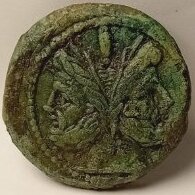
King John Inviato 18 Gennaio, 2018 Autore #1345 Inviato 18 Gennaio, 2018 Volaterrae. Etruria. Dupondius. ( Ae g ) Circa 225-215 BC. Janiform head of Culsan wearing pointed petasos. R/ FELA-ODI retrograde (Etruscan Velathri) around club and mark of value II. Haeberlin pl. 83, 1; Thurlow-Vecchi 85; Sydenham Aes Grave 305; HN Italy 109a. Light green patina. Very fine.Estimate: CHF 1500 / euro 960 ILLUSTRAZIONE: GUERRIERI ETRUSCHI Cita Awards
King John Inviato 19 Gennaio, 2018 Autore #1346 Inviato 19 Gennaio, 2018 HADRIAN, A.D. 117-138. Bronze Paduan Sestertius (28.40 gms), 16th Century or Later.After an original by Cavino, this specimen may be a later cast or electrotype. C.f. Klawans #1."HADRIANVS AVGVSTVS." His bare-headed draped and cuirassed bust right; Reverse: "FELICITATI AVG. COS. III. P. P. S. C." Ship moving right Neptune at bow holding a sceptre. Dark brown patina.VERY FINE. Cita Awards
King John Inviato 19 Gennaio, 2018 Autore #1347 Inviato 19 Gennaio, 2018 THRACE, Philippopolis. Caracalla, 198-217. 8 Assaria or Medallion (Bronze, 41mm, 35.67 g 1), 214. ANTΩNEINOC AVT K M AVP CEVH Laureate heroic-style bust of Caracalla to left, seen from behind, wearing aegis. Rev. KOINON ΘPAKΩN AΛEZAND ΠYΘI / A EN ΦIΛIΠ / Π-O Caracalla riding horse springing to right, thrusting his spear at fallen foe. Cf. Mouchmov 5334. SNG Copenhagen -. Varbanov 1421. Black patina. Heavily smoothed and tooled, otherwise , about very fine. ILLUSTRAZIONE: L'IMPERATORE CARACALLA A CAVALLO Cita Awards
King John Inviato 19 Gennaio, 2018 Autore #1348 Inviato 19 Gennaio, 2018 Manuel Comnenus. Curopalates, late 11th-early 12th century. PB Seal (31mm, 32.79 g, 12h). O/D/H/M/H down left field; T/PI/O/C down center; [G]EO/RG/IO[C] down right field; Sts. Demetrius and George standing facing; Demetrius holding spear or banner in right hand and oval shield in left; George holding spear in right hand, with which he transfixes serpent below, and small round shield (buckler) in left / +KE RO/ Tw Cw D(OY)/ MANOVHL/ K(OY)POPALA/TH Tw KO/MNHNw in six lines. BLS I -; DOCBS -; Seyrig -; Vatican -; Orghidan -; Jordanov -. Good VF, smooth gray-brown patina, slight roughness on reverse.From the Robert E. Hecht Collection. Ex Triton X (9 January 2007), lot 864.The military saints and martyrs Demetrius and George became familiar iconographic types during the rule of the Comnenid dynasty. This seal is an early depiction of George as the dragon or serpent slayer, which is not seen in Byzantine art much before the 12th century. The identity of the owner of the seal cannot be positively ascertained. It could be the future emperor Manuel I (1143-1180), holding the junior office of curopalates early in his career, but other possibilities are his uncle of the same name, or a brother of his grandfather, Alexius I, the first emperor of the dynasty.Estimate: 1500 USD ILLUSTRAZIONE: IMPERATORE BIZANTINO DELL'UNDICESIMO SECOLO Cita Awards
King John Inviato 21 Gennaio, 2018 Autore #1349 Inviato 21 Gennaio, 2018 KINGS of BOSPOROS. Kotys II. AD 123/4-132/3. Æ 48 Units (23mm, 8.61 g, 12h). Struck AD 123-126. Diademed and draped bust right / Kotys II on horseback galloping right, brandishing spear; MH (mark of value) in exergue. MacDonald 432/1; Anokhin 491. VF, brown patina, smoothed and tooled. Cita Awards
King John Inviato 21 Gennaio, 2018 Autore #1350 Inviato 21 Gennaio, 2018 KORKYRA, Korkyra. Roman rule. Circa 229-48 BC. Æ 21mm (8.40 g, 1h). Philonidas, magistrate. Laureate head of Poseidon right / Trireme left; FILONIDAS above. SNG Evelpidis 1985-1988; SNG Copenhagen 239. VF, green patina, light roughness.From the Alexandre de Barros Ship Collection.ANCIENT MARITIME VESSELS ON COINSSelections FromThe Alexandre de Barros CollectionClassical Numismatic Group is pleased to present the Alexandre de Barros collection of ships on ancient coins. Assembled with a view toward creating a broad overview of Greek and Roman ship types, this collection features some of the earliest examples of ships known on coins. Of particular interest is a Phoenician double shekel struck in Sidon in the late fifth century BC, one of the earliest coins to feature a ship. The collection ends with the issues of Carausius and Allectus, the late third century AD British usurpers.Estimate: $150 Cita Awards






Risposte migliori
Unisciti alla discussione
Puoi iniziare a scrivere subito, e completare la registrazione in un secondo momento. Se hai già un account, accedi al Forum con il tuo profilo utente..