King John Inviato 30 Novembre, 2018 Autore #2526 Inviato 30 Novembre, 2018 (modificato) Classical Numismatic Group > Electronic Auction 434 Auction date: 12 December 2018 Lot number: 104 Lot description: PAMPHYLIA, Aspendos. Circa 465-430 BC. AR Stater (17mm, 10.85 g). Warrior advancing right, holding shield and spear; letter(?) between legs / Triskeles within incuse square. CNG E-432, lot 83 (same dies); CNG E-429, lot 167 (same dies); Savoca Online Auction 26, lot 240 (same dies); otherwise, unpublished in the standard references. VF, compact flan. Struck from fresh and artistic dies. Estimate: 300 USD Modificato 30 Novembre, 2018 da King John Cita Awards
King John Inviato 30 Novembre, 2018 Autore #2527 Inviato 30 Novembre, 2018 V.L. Nummus OG > Auction 5 Auction date: 29 October 2016 Lot number: 130 Lot description: Republic C. Gellius (138 BC) Denarius Rome.Helmeted head of Roma, behind X.Rv. Warriors in quadriga, CN GEL and ROMA in ex. Crawford 232/1. 3.80 g. Spl+ / XF+ Estimate: 80 EUR Cita Awards
King John Inviato 30 Novembre, 2018 Autore #2528 Inviato 30 Novembre, 2018 Roma Numismatics Ltd > E-Live Auction 4 Auction date: 29 November 2018 Lot number: 74 Price realized: 1,100 GBP (Approx. 1,403 USD / 1,244 EUR) Note: Prices do not include buyer's fees. Lot description: North Africa, Carthage AR Shekel. Time of Hannibal. Carthago Nova, circa 218-206 BC. Bare male head (Hannibal?) left / Horse right, palm tree behind. CNH 74; ACIP 614. 5.96g, 21mm, 12h. Very Fine. Very Rare. From a private German collection. This coin is conventionally believed to carry the portrait of Hannibal on the obverse. In 237 BC Hamilcar Barca, after having lost the First Punic War against Rome, but having won the Mercenary War against the Libyans, disembarked at Gadir with a Carthaginian expedition with the purpose of "re-establishing Carthaginian authority in Iberia" (Polybios, Histories, 2.1.6), and within 9 years he had expanded the territory of Carthage well into the Iberian peninsula, securing control of the southern mining district of Baetica and Sierra Morena, before dying in battle in 228. Hamilcar was succeeded by his son-in-law Hasdrubal the Fair who expanded the new province by skilful diplomacy and consolidated it with the foundation of Akra Leuka, Mahon and finally in 227, Qart Hadasht (Latin: Carthago Nova) as his capital. After his untimely death in 221 he was succeeded by Hannibal (247-182), oldest son of Hamilcar Barca, and Hamilcar's second son Hasdrubal (245-207 BC). The Barcids now wielded control over much of the mineral rich Mediterranean side of the peninsula until 219 when Hannibal made the fateful move of taking and sacking Saguntum, a well established Roman ally. The wholesale slaughter of this Roman ally's population, and the arrogance with which the Roman ambassadors sent to Carthage to seek redress were met, led directly to the Second Punic War: the great statesman Quintus Fabius, speaking to the Carthaginian senate, gathered a fold of his toga to his chest and held it out, saying "Here, we bring you peace and war. Take which you will." The Carthaginians replied "Whichever you please - we do not care." Fabius let the fold drop and proclaimed "We give you war." Estimate: 1000 GBP illustrazione: Annibale attraversa le Alpi Cita Awards
King John Inviato 30 Novembre, 2018 Autore #2529 Inviato 30 Novembre, 2018 Emporium Hamburg, Auction 72, lot 133, 13/11/2014 ITALIEN, SIZILIEN / Mamertini in Sizilien, AE 29 (n.288 v.Chr.). Belorb. Kopf des Apollon r., hinter ihm Lyra. Rs.Unbekleideter Krieger auf über einen Felsen ausgebreiteter Chlamys mit Speer und Schild l.sitzend, im Feld l.Monogramm. 14,32g. SNG Cop.454, ss ILLUSTRAZIONE: STELE FUNERARIA DELL'OPLITA DEMOCLEIDE IN SERVIZIO SULLE NAVI (IV SECOLO A.C., MUSEO DEL PIREO, ATENE) Cita Awards
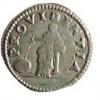
King John Inviato 30 Novembre, 2018 Autore #2530 Inviato 30 Novembre, 2018 Noble Numismatics Pty Ltd > Auction 118 Auction date: 31 July 2018 Lot number: 1922 Tacitus, (A.D. 275-276), billon antoninianus, Rome mint, obv. radiate cuirassed bust to right, around IMP C M CL TACITVS AVG, (4.17 g) rev. Mars standing left, resting on shield, holding olive branch and spear, around CLEMENTIA TEMP, in exergue XXI, Z in right field, (S.11769, RIC 83, C.15) (illustrated). Cita Awards
King John Inviato 1 Dicembre, 2018 Autore #2531 Inviato 1 Dicembre, 2018 (modificato) Gorny & Mosch Giessener Münzhandlung, Auction 126, lot 2099, 14/10/2003 RÖMISCHE PROVINZIALPRÄGUNGEN PALÄSTINA Römische Prokuratoren Objekt-Nr.: 2099 Pontius Pilatus AE Prutah (2,13 g.), 30n.Chr. Vs.: TIBERIOU KAISAROS, Lituus. Rs.: Jahreszahl LIZ (17) in Kranz. Meshorer 23. Grüne Patina, ss Estimation: € 250,00 ILLUSTRAZIONE: GESU' DAVANTI A PONZIO PILATO Modificato 1 Dicembre, 2018 da King John Cita Awards
King John Inviato 1 Dicembre, 2018 Autore #2532 Inviato 1 Dicembre, 2018 Numismatica Ars Classica NAC AG, Auction 25, lot 461, 25/06/2003 The Roman Empire Antinous, favorite of Hadrian No.: 461 Schätzpreis - Estimate CHF 55000 d=38 mm Medallion, Bithynium-Claudiopolis Bythiniae, æ 43.95 g. H PATRIC - ANTINOON - QEON Bare-headed and draped bust l. Rev. BEIQUNIEWN - ADRIANWN Draped figure of Antinous standing l., head reverted, outstretching r. hand to reed before him and holding in l. pedum; at his side ox l. In field above, star. BMC Bythinia p. 117, 3. G. Bloom, Numismatique de Antinoos, JIAN 16, 1914, p. 44, 8 and pl. 2, 14 (this reverse die). Cf. Giessener Münzhandlung sale 76, 1996, 310 (this obverse die). Excessively rare. A marvellous portrait of Antinous of extraordinary style, undoubtely one of the finest representation of the favourite of Hadrian. Superb green patina and the reverse from a weak die, otherwise about extremely fine / good very fine The appearance on coinage of Antinous, a personal companion of the emperor Hadrian, is in itself remarkable: he was not related to the emperor by blood or marriage, and was never an heir-apparent. Indeed, Antinous is honored only after his death and deification, the latter of which sometimes is stated explicitly, and more often is communicated in his description as a ‘hero’. In those cases the term ‘hero’ describes a mortal who, though his virtuous acts, attains immortality. Frequently Antinous was assimilated with various gods, most commonly Apollo, Hermes, Dionysus, Iacchus and Osiris. On the obverse of this piece Antinous is celebrated as a true god – a full divinity – as indicated by the inscription beneath his bust. Antinous’ cult was widespread, and a great many busts were produced: at least 1,500 can be presumably attested, of which at least 115 survive today. His coin issues were also substantial, with more than 30 mints striking them in approximately 150 different issues. Though most of these coins were struck during the reign of Hadrian, concentrating from 134 to 137, it is believed that a few mints struck them as late as the reign of Marcus Aurelius, and that Bithynium, where this piece was struck, perhaps coined them as late as the time of Caracalla This large and impressive object, appropriately called a ‘provincial medallion’, was struck at Antinous’ birthplace, Bithynium-Claudiopolis, in Bithynia. The reverse shows him looking back over his shoulder as he advances left, toward a tall, reed-like plant; beside him is a grazing bull, and above is a star. The bull has been taken by some as a symbol of Antinous’ death, and the star, obviously, as a symbol of his divinity. Though Antinous is usually described as here being in the guise of Hermes, Wroth’s view that it is "a representation of Antinous as the divinised herdsman of Bithynium – a place famous for its pastures" is more appealing. He drew particular inspiration for his view from the star above Antinous’ head. We should also note that the pedum (lagabolon) Antinous holds, though principally meant to be thrown at hares to kill them, often is described in a more general fashion as a shepherd’s staff. The active and elaborate composition of the scene suggests it was copied from a prototype – perhaps a statuary group, but more likely a mosaic or painting, the latter of which are attested to in Bithynium-Claudiopolis ILLUSTRAZIONE: STATUA DI ANTINOO Cita Awards
King John Inviato 1 Dicembre, 2018 Autore #2533 Inviato 1 Dicembre, 2018 Roma Numismatics Limited, aUCTION 5, LOT 752, 23/03/2013 Trajan AR Denarius. Trajan AR Denarius. Rome, AD 103-104. IMP TRAIANO AVG GER DAC P M TR P, laureate bust right, drapery on far shoulder / COS V P P SPQR OPTIMO PRINC, trophy of arms, consisting of a helmet at top, oval shields, crossed greaves, two spears and two curved swords. BMC 355; RSC 99 var. (two spears and two swords); RIC -. 3.13g, 19mm, 7h. Good Very Fine. Extremely Rare. illustrazione: scudi celtici Cita Awards
King John Inviato 1 Dicembre, 2018 Autore #2534 Inviato 1 Dicembre, 2018 Numismatik Naumann (formerly Gitbud & Naumann), Auction 16, lot 880, 4/05/2014 TRAJAN (98-117). Denarius. Rome. Obv: IMP TRAIANO AVG GER DAC P M TR P. Laureate bust right, slight drapery on far shoulder. Rev: COS V P P SPQR OPTIMO PRINC. Trophy; at base two spears and one dacian falx. Woytek 268b-C1. Condition: Extremely fine. Weight: 3.10 g. Diameter: 18 mm. Cita Awards
King John Inviato 1 Dicembre, 2018 Autore #2535 Inviato 1 Dicembre, 2018 Dr. Busso Peus Nachfolger > Auction 423 Auction date: 7 November 2018 Lot number: 414 Lot description: Kaiserliche Prägungen Postumus in Gallien, 259-269. Doppelsesterz 261, Colonia Agrippinensis (Köln). Büste / Kaiser mit Helm zu Pferd vor vier Soldaten mit drei Standarten. RIC 117; Elmer 199 (Köln); Bastien, Postume 154 (Atelier II). 17.47 g.; Dunkelgrüne Patina Selten Sehr schön Estimate: 500 EUR Cita Awards
King John Inviato 2 Dicembre, 2018 Autore #2536 Inviato 2 Dicembre, 2018 Numismatik Naumann (formerly Gitbud & Naumann) > Auction 67 Auction date: 1 July 2018 Lot number: 337 Price realized: 55 EUR (Approx. 64 USD) Note: Prices do not include buyer's fees. Lot description: TROAS. Alexandria. Pseudo-autonomous. Time of Trebonianus Gallus (251-253). Ae As. TROAS. Alexandria. Pseudo-autonomous. Time of Trebonianus Gallus (251-253). Ae As. Obv: CO ALEX TR. Turreted and draped bust of Tyche right; to left, CO/AV in two lines on vexillum. Rev: COL AVG / TRO. Alexander III 'the Great' of Macedon, raising hand, on horse rearing left; to left, statue of Apollo Smintheus right, with patera, bow and quiver over shoulder. RPC IX 468; Bellinger A475. Condition: Very fine, some edge faults. Weight: 4.9 g. Diameter: 23 mm. Estimate: 50 EUR ILLUSTRAZIONE: STATUA IN BRONZO DI ALESSANDRO IL GRANDE Cita Awards
King John Inviato 2 Dicembre, 2018 Autore #2537 Inviato 2 Dicembre, 2018 (modificato) Gorny & Mosch Giessener Münzhandlung > Online Auction 259 Auction date: 20 October 2018 Lot number: 3439 Lot description: MAKEDONIEN. KOINON. Pseudo-autonom. AE (13,58g). 3. Jh. n. Chr. Vs.: ALEXANDROU, Kopf Alexanders des Großen mit Diadem und wehenden Haaren n. r. Rs.: KOINON MAKEDONWN OMONOI/A, Alexander der Große mit nach hinten wehender Chlamys, in der Rechten Lanze haltend, auf seinem Pferd Bukephalos nach rechts galoppierend, unter dem Pferd Stern. AMNG III 339. Grüne Patina, Vs. Kratzer, gutes ss Estimate: 50 EUR ILLUSTRAZIONE: ALESSANDRO IL GRANDE Modificato 2 Dicembre, 2018 da King John Cita Awards
King John Inviato 2 Dicembre, 2018 Autore #2538 Inviato 2 Dicembre, 2018 Macho & Chlapovič, Auction 7, lot 17, 15/11/2014 Celtic Southwestern Slovakia (Bratislava ) Boii / Kelten Südwesten Slowakei ( Pressburg ) Boier Hexadrachm, BIATEC type / Hexadrachme, typ BIATEC, 16,71 g, 25,5 mm, Ag, Göbl 1994, č. II/1(2/2) Heads of man and woman to right (Honos and Virtus), leaf below and on the right side / Rider on the horse to right holding bridle in his right hand and branch in the left hand. Text BIATEC below Good VF, Cita Awards
King John Inviato 2 Dicembre, 2018 Autore #2539 Inviato 2 Dicembre, 2018 Ira & Larry Goldberg Coins & Collectibles, Auction 69, lot 3000, 29/05/2012 Celtic Gaul. Rennes Region (Bretagne). Gold Stater (7.72 g) struck c. 2nd century BC. EF Celtic Gaul. Rennes Region (Bretagne). Gold Stater (7.72 g) struck c. 2nd century BC. Laureate head right of Apollo. Reverse: Naked female on horseback right, holding shield and brandishing spear; above, stars; below; musical instrument; to right, wheel. BN 6757. Well centered and unusually well struck. Extremely Fine and exceedingly rare. The rider on this revrese type is commnoly identified as Epona, but, as a protectress of horses, a fertility goddess, and a leader of souls into the afterlife, Epona is usually depicted elsewhere in Celtic art with attributes such as the patera and cornucopiae rather than weaponry. The warrior-queen advancing into battle was, however, a popular theme in Celtic legend, and may well be represented here. Estimated Value $40,000 - 50,000. Cita Awards
King John Inviato 2 Dicembre, 2018 Autore #2540 Inviato 2 Dicembre, 2018 Fritz Rudolf Künker GmbH & Co. KG, Auction 280, lot 377, 26/09/2016 RÖMISCHE MÜNZEN MÜNZEN DER RÖMISCHEN REPUBLIK AR-Denar, 48 v. Chr., Rom, L. Hostilius Saserna; 3,84 g. Kopf eines gallischen Kriegers (wohl des Vercingetorix) r.//Gallischer Krieger steht l. mit Schild und Speer in r. fahrendem Streitwagen. Bab. 2; BMC 3994; Crawf. 448/2 a; Syd. 952. RR Prüfpunzen auf dem Avers, sehr schön-vorzüglich Vercingetorix war der Führer des großen Gallieraufstandes gegen Caesar im Jahre 52 v. Chr. Nach dem Fall Alesias mußte Vercingetorix sich ergeben. Die berühmte clementia Caesaris wurde ihm nicht zuteil; nach sechs Jahren Haft wurde er im Tullianum hingerichtet. Der Revers zeigt einen gallischen Streitwagen (Essedum) mit Wagenkämpfer (Essedarius) und Lenker (Auriga). Die Streitwagen wurden vor allem gegen Kavallerie eingesetzt. ILLUSTRAZIONE: VERCINGETORIGE, PRINCIPE E CONDOTTIERO GALLO Cita Awards
King John Inviato 2 Dicembre, 2018 Autore #2541 Inviato 2 Dicembre, 2018 (modificato) Roma Numismatics Ltd > E-Live Auction 2 Auction date: 30 August 2018 Lot number: 608 Price realized: 360 GBP (Approx. 468 USD / 400 EUR) Note: Prices do not include buyer's fees. Lot description: Anonymous PB Tessera. Circa 1st-3rd century AD. Gladiator in defensive stance to right, holding sword and shield, facing lion advancing left / AS. Cf. Rostowzew 574 var. (QP on rev.). 3.14g, 19mm, 7h. Very Fine. Very Rare. Estimate: 50 GBP Modificato 2 Dicembre, 2018 da King John Cita Awards
King John Inviato 3 Dicembre, 2018 Autore #2542 Inviato 3 Dicembre, 2018 VAuctions > Auction 323 Auction date: 17 March 2017 Lot number: 427 price realized: 100 USD (Approx. 93 EUR) Note: Prices do not include buyer's fees. Lot description: Pub. Crepusius. 82 B.C. AR denarius (17 mm, 3.97 g, 9 h). Rome. Laureate head of Apollo right, scepter at shoulder; behind, F; below chin, uncertain symbol / P · CREPVS in exergue, horseman rearing right, hurling spear; behind, CLXXXXIIII. Crawford 361/1c; Sydenham 738a; Crepusia 1. Lightlt toned. Very fine. From the Big Sky Collection. The moneyer's family is little known, and the moneyer himself is only known from his coins. This issue of denarii was quite massive, however, with controls numbers reaching DXX. According to Crawford, the control numerals on the reverse form a continuous sequence with no control-numeral having more than one die. Crawford 361/1a, the only variety without obverse control, is extremely rare while the rest of P. Crepusius' denarii are all quite common. Estimate: 100 USD ILLUSTRAZIONE: LA CAVALLERIA NUMIDA Cita Awards
King John Inviato 3 Dicembre, 2018 Autore #2543 Inviato 3 Dicembre, 2018 (modificato) Classical Numismatic Group > Triton XXII Auction date: 8 January 2019 Lot number: 864 Lot description: C. Piso L.f. Frugi. 61 BC. AR Denarius (17mm, 4.00 g, 6h). Rome mint. Laureate head of Apollo right; scorpion behind / Horseman, holding palm frond, reins and wearing conical hat, on horse galloping right; fish above, C • PISO • L • F FRVG below. Crawford 408/1a (O18/R15); Hersh, Piso 59 (O20/R1019); Sydenham 854a; BMCRR Rome 3789; Calpurnia 24i. Superb EF, deep reflective luster. From the Alan J. Harlan Collection, purchased from Freeman & Sear. Estimate: 750 USD ILLUSTRAZIONE: "APOLLO DI MANTOVA" CONSERVATO AL MUSEO DEL LOUVRE, COPIA ROMANA DEL I-II SECOLO A.C. DA UN ORIGINALE GRECO DEL V SECOLO A.C. Modificato 3 Dicembre, 2018 da King John 1 Cita Awards
King John Inviato 3 Dicembre, 2018 Autore #2544 Inviato 3 Dicembre, 2018 (modificato) Classical Numismatic Group, Auction 96, lo 189, 14/05/2014 THESSALY, Larissa. Circa 370-360 BC. AR Drachm (20mm, 6.06 g, 1h). Bull leaping right; ethnic with large lettering above / Thessalian cavalryman on horse leaping right. Lorber, Thessalian 101; BCD Thessaly II 186. Good VF, slight die shift, struck with worn obverse die, small nick in field on obverse. From the BCD Collection. Modificato 3 Dicembre, 2018 da King John 1 Cita Awards
King John Inviato 3 Dicembre, 2018 Autore #2545 Inviato 3 Dicembre, 2018 Fritz Rudolf Künker GmbH & Co. KG, Auction 288, lot 752, 13/03/2017 RÖMISCHE MÜNZEN MÜNZEN DER RÖMISCHEN KAISERZEIT Severus Alexander, 222-235 Æs, 231 (?), Beroia für das Koinon Makedonon (Macedonia); 10,92 g. Kopf Alexanders des Großen r. mit Diadem//Alexander der Große steht r. und zähmt Bukephalos. AMNG 368 var. RR Fast sehr schön Exemplar der Sammlung Dr. Rainer Pudill. Erworben am 29. Oktober 2011 bei der Firma Lanz, München. ILLUSTRAZIONE: ALESSANDRO DOMA BUCEFALO. 1 Cita Awards
King John Inviato 3 Dicembre, 2018 Autore #2546 Inviato 3 Dicembre, 2018 Nomos, Auction 4, lot 1152, 10/05/2011 Coins of Thessaly, the BCD Collection Larissa Circa 380-365 BC. Drachm (Silver, 5.99 g 10). Head of nymph Larissa facing, head turned slightly to left, wearing circlet with grain ears, triple-pendant earring and simple necklace. Rev. LA-R - ISAIWN Helmeted and armored cavalryman riding prancing horse to right, holding goad in his right hand. Lorber, Middle . Series V, O1/R1. A lovely coin, nicely toned. Extremely fine. Cita Awards
King John Inviato 3 Dicembre, 2018 Autore #2547 Inviato 3 Dicembre, 2018 Bertolami Fine Arts, Auction 6, lot 902, 10/12/2012 Hadrian (117-138), Sestertius,Rome, AD 121-122, AE, (g 23,97, mm 33, h 6). IMP CAESAR TRAIAN - HADRIANVS AVG, laureate, draped and cuirassed bust r., Rv. P M - TR P - CO - S - III, emperor on prancing horse l., raising hand and holding spear; in ex. EXPED AVG / S C. RIC 613b; C 593.Scarce. Leather patina. Bolt portrait. Reverse exceptionally detailed. Exceptional preservation for the type. Extremely fine / Good extremely fine. Cita Awards
King John Inviato 3 Dicembre, 2018 Autore #2548 Inviato 3 Dicembre, 2018 (modificato) Numismatica Ars Classica NAC AG, Auction 78, lot 277, 26/05/2014 Greek Coins Kings of Bithynia. Nicomedes I, 279 – 255 Tetradrachm circa 279-255, AR 16.91 g. Diademed head r. Rev. BAΣIΛEΩΣ / NIKOMEΔOΥ Warrior goddess (Thracian Bendis?) seated l. upon rock, holding spear and sword in its scabbard; a shield at her feet and behind, the stump of a tree. In outer l. field, Nike and in inner l. field, monogram. Waddington 1 and pl. XXIX, 2 (these dies). Hellenistic Kingdoms 186 (this obverse die). Mørkholm 414 (this obverse die). Extremely rare, only very few specimens known. An attractive portrait of fine Hellenistic style, good very fine / about extremely fine According to Herodotus those who would rule the Bithynian Kingdom were descendants of tribesmen from the Strymon valley in Thrace who had been driven from their homeland by invaders, and had crossed the Bosphorus and with little opposition to settle Bithynia. For several generations the chieftains of the Bithyni maintained quasi-independence under Persian oversight and achieved even greater autonomy after the campaign of Alexander III, who bypassed this region. Early in the 3rd Century B.C. one of these chieftains, Zipoetes, established rule over the entire region and became the first king of Bithynia. He rebuffed Macedonian advances on several occasions, and sometime around 280 B.C. he died, apparently at an advanced age. He was succeeded by his eldest son Nicomedes, who promptly killed all of his brothers except one, named Zipoetes, who escaped and temporarily ruled part of the kingdom. Relatively little is recorded of this Nicomedes’ deeds, though clearly he was talented and aggressive, for he enlarged his kingdom enough to acquire a port on the eastern shore of the Propontis, where he established his capital of Nicomedia. He was a philhellene who did much to encourage Greek ways in his territory. This must have required a concerted effort, for Herodotus describes the Bithyni as a wild, savage people who wore fox skins on their heads when going into battle. The fact that he was given a Greek name, Nicomedes, suggests that his father Zipoetes must also have had Hellenising aspirations. One of Nicomedes’ actions had a profound and lasting impact on Asia Minor as a whole. In 278/7 he negotiated an agreement with Gauls (who in 280/79 had caused havoc in Macedon), by which they were allowed to migrate en masse to Asia Minor. His objective was to gain mercenaries for his struggles against his brother, other regional foes, and the Seleucid King Antiochus I. Though the Gaulish reinforcements aided Nicomedes as promised, they soon took to brigandage and eventually suffered defeats from the Pergamene King Philetaerus, and by Antiochus I in about 270. Thereafter, they were settled in a part of northern Phrygia that came to be known as Galatia. Nicomedes was the first of eight Bithynian kings to strike coins, with his being especially rare. His tetradrachms, which appear to have been produced soon after Nicomedes founded his eponymous capital in c.264/260 B.C., rank among the prizes of Hellenistic-era coinage. His designs are essentially derived from the Alexander-Athena tetradrachms of Lysimachus, who had issued them in enormous quantities for fifteen years in western Asia Minor. The portrait of Nicomedes, described by Newell as embodying “...the rugged features of a strong-willed, able and pertinacious man,” is engraved in an excellent style that reflects Nicomedes’ desire to be seen as a Hellenistic king on par with his rivals. While his features are truly individualized, the portrait recalls the image of Lysimachus’ Alexander with its heavy, sculpted brow and pronounced nose and chin. The reverse blends the familiarity of Lysimachus’ universal coinage with local culture by depicting the warrior-goddess Bendis, the Thracian Artemis, in a format resembling the seated Athena type. It cannot be mere chance that the rock upon which Bendis sits is contoured to resemble Athena’s throne, and that the shield resting against it is somewhat Gaulish in appearance. In this case Nicomedes may even have been inspired by Aetolian League coins that depict Aetolia seated on a pile of Gallic shields, a design which probably was inspired by a sculpture in the temple of Apollo at Delphi that marked the repulse of the Gallic invasion in 279 B.C. Modificato 3 Dicembre, 2018 da King John Cita Awards
King John Inviato 4 Dicembre, 2018 Autore #2549 Inviato 4 Dicembre, 2018 Nomos, Auction 4, lot 1218, 10/05/2011 Coins of Thessaly, the BCD Collection Olosson First half of the 4th century BC. Dichalkon (Bronze, 15mm, 3.42 g 3). Thessalian cavalryman, wearing petasos and chlamys, riding galloping horse to right. Rev. OLOSSO - N - I - WN Zeus Keraunios striding right, his chlamys over his shoulders, hurling thunderbolt with his right hand and with an eagle on his outstretched left. S. Lavva, Zur Münzprägung von Olosson, La Thessalie, Actes du Colloque International. Lyon, 1990 (Athens, 1994), p. 315, 2 = fig. 2 ( this coin ). Extremely rare, the second and best example known . Clear and well-struck with a dark brown patina. About extremely fine. This coin was struck by the Perrhaiboi in honor of their mint city, Olosson. A note from BCD : The discovery of this coin in the name of the Olossonians was one of the highlights of my collecting experience. To acquire a totally new coin type with a new legend that makes sense at first glance is indeed a treat for the specialized collector. ILLUSTRAZIONE: STATUETTA IN BRONZO DI ZEUS KERAUNIOS DA DODONA (BERLINO, ALTES MUSEUM) Cita Awards
King John Inviato 4 Dicembre, 2018 Autore #2550 Inviato 4 Dicembre, 2018 Nomos, Auction 4, lot 1230, 10/05/2011 Coins of Thessaly, the BCD Collection Pelinna Later 4th century BC. Dichalkon (Bronze, 19mm, 4.63 g 5). Armored Thessalian cavalryman, with helmet and couched lance, on horse galloping to left. Rev. PELINNAEIWN Mantho, draped and veiled. standing right, holding open casket in her left hand and key in her right. Moustaka 1998, 6. SNG Munich 134. Rare. With a beautiful green patina. Minor flan crack, otherwise , nearly extremely fine. Cita Awards






Risposte migliori
Unisciti alla discussione
Puoi iniziare a scrivere subito, e completare la registrazione in un secondo momento. Se hai già un account, accedi al Forum con il tuo profilo utente..