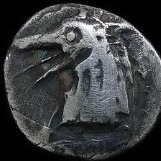
eracle62 Inviato 10 Agosto, 2018 #1976 Inviato 10 Agosto, 2018 10 ore fa, King John dice: The New York Sale Auction xxvii, lot 23, date 4/01/2012 The Prospero Collection of Ancient Greek Coins. ITALY. Calabria , Tarentum (c.344-338 B.C.), Gold Stater, 8.56g,. Head of Hera facing to right, her curling hair held in a stephane decorated with palmettes, a diaphanous veil is visible on both sides of her neck, small E behind, a small dolphin swimming downwards and TAPA before. Rev. TAPANTINΩN , Taras standing to right, raising his hands in supplication towards Poseidon, seated to left on a stool, wearing a himation over his lower limbs and holding a trident, K beneath stool, a star and ├ on right (E.S.G. Robinson, Ancient Greek Coins in the possession of William Harrison Woodward (privately printed, Oxford, 1928), no. 4 (this coin); Vlasto 1 (these dies); Vlasto, ‘Les monnaies d’or de Tarente’, JIAN II, 1899, p. 306, I; A.J. Evans, ‘The Artistic Engravers of Terina and the Signature of Evaenetos on its later Didrachm Dies’, NC 1912, p. 45; Head, BM Principal Coins, pl. 25, 7 (these dies); HN Italy 901 (these dies); Kraay - Hirmer pl. 109, 315, and colour plate X). Two small insignificant nicks on the obverse and one on the reverse edge, extremely fine and very rare, a superb example and one of the most beautiful designs to appear on an ancient Greek gold coin. This coin published in ‘Ancient Greek Coins in the possession of William Harrison Woodward’, E.S.G. Robinson (1928), p. 2, 4, illustrated on pl. I. Ex Sir Arthur J. Evans Collection Ex William Harrison Woodward Collection Ex Reverend Arnold Mallinson Collection, Spink Auction 39, London, 6 December 1984, lot 36 The obverse of this coin bears a very delicately engraved head of Hera, the wife of Zeus. On the reverse appears ‘K’, probably the initial of the artist responsible for the types of this beautiful coin. It is possible that this is the same artist who engraved beautiful dies, signed ‘Kal’, at Herakleia (see lot 46 for an example). The fascinating reverse type of the above coin has been given various historical interpretations, associating it with an appeal made by Tarentum around this time for aid to help control increasing pressure from the surrounding tribes of Lucanians and Messapians. Taras is shown appealing to his father Poseidon, and the parent city of Tarentum was Sparta, to whom they did appeal for help at this time. An alternative historical association could be the campaign of intervention by Alexander of Epirus, the uncle of Alexander the Great, undertaken after the Spartan one. Whatever the inspiration for the reverse type, the whole scene is a composition of great complexity and detail, and has been beautifully and finely engraved. The arrangement of the figures gives the viewer a genuine sense of realism and movement. Taras appears almost desperate in his appeal and Poseidon, gazing down upon Taras, is rendered with gentle and sympathetic body-language. This superb coin is a very interesting example of a mythological type that perhaps reflects the current historical events at the time of issue. US$ 70,000 ILLUSTRAZIONE: POSEIDONE, APOLLO E ARTEMIDE SEDUTI, FREGIO IN MARMO PENTELICO DEL PARTENONE, OPERA DI FIDIA La magnificenza del pezzo è indiscutibile, sono combattuto fra Era e Poseidone, che incisore... 1 Cita
King John Inviato 11 Agosto, 2018 Autore #1977 Inviato 11 Agosto, 2018 (modificato) GRIECHISCHE MÜNZEN MYSIEN KYZIKOS Pseudo-autonomes Bronze-Medaillon, Zeit des Severus Alexander, unter dem Archonten C. Flavius Trophimos. KOPH - CWTEIPA. Drapierte Büste der Kore von Kyzikos mit Ährenkranz und Perlenkette nach rechts. Rs: ЄPI G FL TPOFIMOV AP KVZ/IKHNWN NЄW/KOPWN. Raub der Persephone: Hades in Quadriga im Galopp nach rechts fahrend, im linken Arm die widerstrebende Persephone, dahinter kleiner Krieger mit Lanze und Schild laufend, unter den Pferdehufen umgestürzter Korb und Schlange, über der Quadriga Eros nach rechts fliegend. BMC -; SNG von Aulock -; SNG France 5 -; SNG Tübingen -; zum Beamtennamen siehe Leschhorn II 851. 23,48g. Sehr selten. Vorzüglich. ILLUSTRAZIONE: LA BATTAGLIA DI MARATONA Modificato 11 Agosto, 2018 da King John 1 Cita Awards
King John Inviato 11 Agosto, 2018 Autore #1978 Inviato 11 Agosto, 2018 Classical Numismatic Group, Inc. Electrinic Auction 311, lot 229, 25/09/2013 THESSALY, Pelinna. Circa 425-350 BC. Æ Chalkous (15mm, 2.00 g, 2h). Horseman, wearing helmet and short chiton, about to strike with spear at a fallen enemy to lower right, covering himself with shield / ΠEΛΛ[IN?]–IKON (sic), warrior to left, seen partly from behind, wearing petasos and short chiton, holding spear in raised right hand and shield in left. Rogers 426 var. (rev. legend); BCD Thessaly II 530.2 var. (same); CNG e183, lot 47 (same rev. die). Good VF, glossy green patina. Attractive surfaces. From the BCD Collection. Cita Awards
King John Inviato 11 Agosto, 2018 Autore #1979 Inviato 11 Agosto, 2018 MAGNUS MAXIMUS Maiorina pecunia, (MB, Æ 2) 383-388 Viennoise, Arles R2 copper (21mm, 5,01g, 11h) Obverse : D N MAG MAXI-MVS P F AVG Buste diadémé, lauré et drapé de Magnus Maximus à droite, vu de trois quarts en avant (A’c) ; diadème à cabochons, perlés Reverse : VICTORI-A AVGG/ -|-// PCON Magnus Maximus debout à gauche, vêtu militairement, tenant le globe nicéphore de la main droite tendue et un labarum chrismé de la main gauche Ref : C.3 RIC.27 a LRBC.553 F.1521 EMA.193 /3-1 Pedigree : Cet exemplaire provient du bulletin Coin & Medal, 845 de B. A. Seaby, 1989, n° C. 648 et de la vente Monnaies et Médailles 92 (Portrait Art in Roman Coinage - The Collection of a friend of the Romans), 22 novembre 2002, n° 374 Grade : EF Coments on the condition : Exemplaire sur un petit flan épais et irrégulier, bien centré des deux côtés. Beau portrait avec une faiblesse de frappe sur la légende. Très joli revers inhabituel. Belle patine vert olive foncé Starting Price : 350.00 Euro Estimate : 550.00 Euro ILLUSTRAZIONE: LEGIONARI E MARINAI ROMANI IN BRITANNIA NEL IV SECOLO D.C., DURANTE LE TURBOLENZE CHE PORTARONO ALLA RIBELLIONE DELL'USURPATORE MAGNO MASSIMO Cita Awards
eracle62 Inviato 11 Agosto, 2018 #1980 Inviato 11 Agosto, 2018 13 ore fa, King John dice: GRIECHISCHE MÜNZEN MYSIEN KYZIKOS Pseudo-autonomes Bronze-Medaillon, Zeit des Severus Alexander, unter dem Archonten C. Flavius Trophimos. KOPH - CWTEIPA. Drapierte Büste der Kore von Kyzikos mit Ährenkranz und Perlenkette nach rechts. Rs: ЄPI G FL TPOFIMOV AP KVZ/IKHNWN NЄW/KOPWN. Raub der Persephone: Hades in Quadriga im Galopp nach rechts fahrend, im linken Arm die widerstrebende Persephone, dahinter kleiner Krieger mit Lanze und Schild laufend, unter den Pferdehufen umgestürzter Korb und Schlange, über der Quadriga Eros nach rechts fliegend. BMC -; SNG von Aulock -; SNG France 5 -; SNG Tübingen -; zum Beamtennamen siehe Leschhorn II 851. 23,48g. Sehr selten. Vorzüglich. ILLUSTRAZIONE: LA BATTAGLIA DI MARATONA Degna di nota vista anche la mia presenza.. 1 Cita
King John Inviato 12 Agosto, 2018 Autore #1981 Inviato 12 Agosto, 2018 (modificato) Numismatik Naumann (formerly Gitbud & Naumann) > Auction 52Auction date: 2 April 2017Lot number: 152 Price realized: 400 EUR (Approx. 428 USD / 342 GBP / 428 CHF) LESBOS. Methymna. Tetrobol (Circa 500/480-460 BC). Obv: Hoplite advancing left, holding shield and spear. Rev: Warrior riding forepart of horse right; all within pelleted linear border within incuse square. SNG von Aulock 1738; HGC 6, 887. Condition: Good very fine. Weight: 2.67 g. Diameter: 13 mm. Estimate: 250 EUR Modificato 12 Agosto, 2018 da King John 1 Cita Awards
King John Inviato 12 Agosto, 2018 Autore #1982 Inviato 12 Agosto, 2018 (modificato) Crete, Polyrhenion AR Stater. 4th century BC. Magistrate Charisthe. Laureate head of Zeus to right / Head of sacrificial bull facing, with pendant fillets hanging from horns; ΧΑΡΙΣΘΕ above, ΠΟΛΥΡΗΝΙΟΝ around. Svoronos (1972) 6, pl. XXV, 29 (same dies); Le Rider (1966) pl. XXXIII, 19 (same dies). 11.43g, 25mm, 1h. Extremely Fine. Extremely Rare, and among the finest known examples. From a private American Collection. Polyrhenion was one the oldest Dorian settlements of Crete, whose etymology is 'rich in lambs'. According to Strabo it was settled in archaic times by Achaian and Lakonian immigrants who gathered into one city the existing population, who had lived in villages, some 7 km inland from the Bay of Kissamos. Excavations from 1938 have exposed several building foundations which defy identification, but it may safely be presumed that one of these was a temple dedicated to Zeus. The bull sacrifice was a universal and key element of Greek religion, and it held particular significance in Crete which was rich in mythological traditions relating to the bull as a divine animal, being either divinely directed or indeed itself a theriomorphic god in bull form. Indeed, the central importance of the bull in Cretan culture was an ancient one predating even the arrival of the Mycenean Greeks in the 14th century BC; twentieth century archaeological excavations begun by Arthur Evans in 1900 dramatically 'resurrected' the lost Minoan civilisation and uncovered a wealth of artefacts which, among other things, portray the bull as a major religious symbol. The mythical origin of the idea of bull or ox sacrifice was believed to be from the story of Prometheos in Hesiod's Theogamy (521-616). At Mekone, in a a sacrificial meal marking the 'settling of accounts' between mortals and immortals, Prometheos purposely deceives Zeus by assigning to him a good-looking portion 'wrapped in glistening fat' that consists of nothing but bones, thus ensuring humans would keep the meat for themselves and burn the bones wrapped in fat as an offering to the gods. ILLUSTRAZIONI: Il gioco del toro, un frammento di affresco rinvenuto nel palazzo di Cnosso, nell'isola di Creta (prima illustrazione); reinterpretazione moderna (seconda illustrazione). Modificato 12 Agosto, 2018 da King John 3 Cita Awards
King John Inviato 12 Agosto, 2018 Autore #1983 Inviato 12 Agosto, 2018 Gemini, LLC > Auction V Lot number: 646 Price realized: 1,600 USD (Approx. 1,196 EUR / 1,089 GBP / 1,802 CHF) Lot description: Pamphylia. Aspendus. Ca. 460-420 BC. Silver stater (10.55 gm). Helmeted, nude hoplite advancing right, holding spear in right hand and round shield in left / ΕΣ, triskeles of human legs, all in shallow incuse square. Hill, J. Ward, Greek Coins and Their Parent Cities, 730 (this coin). Bunbury 347 (this coin). SNG von Aulock 4483 variant. Test cut on reverse. About very fine. Ex Morton & Eden, 13 December 2005, lot 1056; Metropolitan Museum of Art (Sotheby's, New York, 4 April 1973, lot 620); John Ward Collection; Edward Bunbury Collection (Sotheby, Wilkinson & Hodge, 15 June 1896, lot 347). Estimate: US$1000 Cita Awards
King John Inviato 12 Agosto, 2018 Autore #1984 Inviato 12 Agosto, 2018 Classical Numismatic Group > Electronic Auction 289 Auction date: 24 October 2012 Lot number: 302 Price realized: 650 USD (Approx. 501 EUR / 406 GBP / 606 CHF) Lot description: Roman Imperial Gaius (Caligula). AD 37-41. Æ Sestertius (34mm, 28.50 g, 6h). Rome mint. Struck AD 37-38. Laureate head left / ADLOCVT COH, Gaius, bareheaded and togate, standing left on daïs, extending right hand in gesture of address; behind him a sella castrensis (chair); in front of him stand five soldiers right, all helmeted, holding shields, and parazonia; four aquilae behind them. RIC I 32. Good Fine, brown patina, scratches on reverse. The lack of S C suggests that this interesting issue was undertaken and paid for by the emperor. Cassius Dio (59.2) writes “... in company with the senate, he inspected the Pretorians at drill and distributed to them the money that had been bequeathed them, amounting to a thousand sesterces apiece.” Estimate: $750 ILLUSTRAZIONE: PRETORIANO Cita Awards
eracle62 Inviato 13 Agosto, 2018 #1985 Inviato 13 Agosto, 2018 13 ore fa, King John dice: Crete, Polyrhenion AR Stater. 4th century BC. Magistrate Charisthe. Laureate head of Zeus to right / Head of sacrificial bull facing, with pendant fillets hanging from horns; ΧΑΡΙΣΘΕ above, ΠΟΛΥΡΗΝΙΟΝ around. Svoronos (1972) 6, pl. XXV, 29 (same dies); Le Rider (1966) pl. XXXIII, 19 (same dies). 11.43g, 25mm, 1h. Extremely Fine. Extremely Rare, and among the finest known examples. From a private American Collection. Polyrhenion was one the oldest Dorian settlements of Crete, whose etymology is 'rich in lambs'. According to Strabo it was settled in archaic times by Achaian and Lakonian immigrants who gathered into one city the existing population, who had lived in villages, some 7 km inland from the Bay of Kissamos. Excavations from 1938 have exposed several building foundations which defy identification, but it may safely be presumed that one of these was a temple dedicated to Zeus. The bull sacrifice was a universal and key element of Greek religion, and it held particular significance in Crete which was rich in mythological traditions relating to the bull as a divine animal, being either divinely directed or indeed itself a theriomorphic god in bull form. Indeed, the central importance of the bull in Cretan culture was an ancient one predating even the arrival of the Mycenean Greeks in the 14th century BC; twentieth century archaeological excavations begun by Arthur Evans in 1900 dramatically 'resurrected' the lost Minoan civilisation and uncovered a wealth of artefacts which, among other things, portray the bull as a major religious symbol. The mythical origin of the idea of bull or ox sacrifice was believed to be from the story of Prometheos in Hesiod's Theogamy (521-616). At Mekone, in a a sacrificial meal marking the 'settling of accounts' between mortals and immortals, Prometheos purposely deceives Zeus by assigning to him a good-looking portion 'wrapped in glistening fat' that consists of nothing but bones, thus ensuring humans would keep the meat for themselves and burn the bones wrapped in fat as an offering to the gods. ILLUSTRAZIONI: Il gioco del toro, un frammento di affresco rinvenuto nel palazzo di Cnosso, nell'isola di Creta (prima illustrazione); reinterpretazione moderna (seconda illustrazione). Beh questo era un classico al Liceo sul testo dell'Argan... ci hanno sfinito su questo affresco e la sua simblologia... Bastaaaaaa.......... Però il tondello lo riscatta... 1 Cita
King John Inviato 13 Agosto, 2018 Autore #1986 Inviato 13 Agosto, 2018 6 ore fa, eracle62 dice: Beh questo era un classico al Liceo sul testo dell'Argan... ci hanno sfinito su questo affresco e la sua simblologia... Bastaaaaaa.......... Però il tondello lo riscatta... Il vecchio Giulio Carlo Argan... Che nostalgia... 1 Cita Awards
King John Inviato 13 Agosto, 2018 Autore #1987 Inviato 13 Agosto, 2018 Roma Numismatics Limited E-Sale 10, lot 2, 26/07/2014, Hammer 320 GBP Larinum, The Frentani Æ Quincunx. Circa 210-175 BC. Helmeted head of Mars(?) right / Warrior, holding spear and shield, on horse galloping left; LADINOD below, [five pellets in exergue]. Campana 4a; HN Italy 625. 8.52g, 23mm, 10h. Good Very Fine. Very Rare Cita Awards
King John Inviato 13 Agosto, 2018 Autore #1988 Inviato 13 Agosto, 2018 (modificato) Jean Elsen & ses Fils S.A. > Auction 138 Auction date: 8 September 2018 Lot number: 9 Price realized: This lot is for sale in an upcoming auction Lot description: LUCANIE, METAPONTE, AR statère, 330-320 av. J.-C. D/ ?EYKI???? T. barbue, casquée de Leucippe à d. Derrière, parazonium. Sous le cou, K. R/ Epi de blé avec feuille. A g., META. A d., cratère. A la base de la tige, ONA. Johnston A6-10; SNG ANS 409; Rutter, HN, 1562. 7,77g Très rare. Très Beau à Superbe Very Fine - Extremely Fine Provient de notre vente 88, 10 juin 2006, 13. Estimate: 750 EUR Modificato 13 Agosto, 2018 da King John 1 Cita Awards
King John Inviato 13 Agosto, 2018 Autore #1989 Inviato 13 Agosto, 2018 Heritage World Coin Auctions > Long Beach Signature Sale 3067 Auction date: 6 September 2018 Lot number: 30188 CILICIA. Tarsus. Ca. late 5th century BC. AR stater (19mm, 10.48 gm, 11h). NGC AU 4/5 - 4/5. Ca. 420-410 BC. Satrap on horseback riding left, reins in left hand, flower (?) upward in right, eagle perched left on branch behind, ankh upward below / Archer in kneeling-running stance right, quiver over shoulder, drawing bow; two branches downward above ankh left in left field, Aramaic legend to right, all in dotted square within incuse square. SNG France 2, 213 var. (symbols). SNG Levante -. BMC -. Well-centered on somewhat tight flan for the highly artistic dies. Lustrous surfaces. Estimate: 2000-3000 USD 1 Cita Awards
eracle62 Inviato 14 Agosto, 2018 #1990 Inviato 14 Agosto, 2018 9 ore fa, King John dice: Roma Numismatics Limited E-Sale 10, lot 2, 26/07/2014, Hammer 320 GBP Larinum, The Frentani Æ Quincunx. Circa 210-175 BC. Helmeted head of Mars(?) right / Warrior, holding spear and shield, on horse galloping left; LADINOD below, [five pellets in exergue]. Campana 4a; HN Italy 625. 8.52g, 23mm, 10h. Good Very Fine. Very Rare Magnifico questo tondello, l'incisore è riuscito a dare l'idea di un guerriero a cavallo che corre all'attacco velocemente, dando un'idea di movimento pazzesca.. 1 Cita
dabbene Inviato 14 Agosto, 2018 #1991 Inviato 14 Agosto, 2018 11 ore fa, King John dice: Heritage World Coin Auctions > Long Beach Signature Sale 3067 Auction date: 6 September 2018 Lot number: 30188 CILICIA. Tarsus. Ca. late 5th century BC. AR stater (19mm, 10.48 gm, 11h). NGC AU 4/5 - 4/5. Ca. 420-410 BC. Satrap on horseback riding left, reins in left hand, flower (?) upward in right, eagle perched left on branch behind, ankh upward below / Archer in kneeling-running stance right, quiver over shoulder, drawing bow; two branches downward above ankh left in left field, Aramaic legend to right, all in dotted square within incuse square. SNG France 2, 213 var. (symbols). SNG Levante -. BMC -. Well-centered on somewhat tight flan for the highly artistic dies. Lustrous surfaces. Estimate: 2000-3000 USD Fantastica la raffigurazione dell’arciere in incuso, siamo poi ai primordi della monetazione ...eppure che monete ! 1 Cita
King John Inviato 14 Agosto, 2018 Autore #1992 Inviato 14 Agosto, 2018 (modificato) Spink Sale 5014, lot 393, 28/09/2005, Hammer 620 GBP Octavian, AR Denarius, 4.03g, 32-31 B.C., diademed head of Pax right, olive-branch before, cornucopiae behind, rev. [c]aesar divi f, Octavian in military attire, walking right, his right hand raised in adlocutio, holding spear over shoulder in left hand (RIC 253; RCV 1549), lustrous, almost extremely fine / extremely fine, scarce Estimate £ 500-700 BUON FERRAGOSTO!! Il termine Ferragosto deriva dalla locuzione latina Feriae Augusti (riposo di Augusto) indicante una festività istituita dall'imperatore Augusto nel 18 a.C. che si aggiungeva alle già esistenti festività cadenti nello stesso mese, come i Vinalia rustica, i Nemoralia o i Consualia. Era un periodo di riposo e di festeggiamenti che traeva origine dalla tradizione dei Consualia, feste che celebravano la fine dei lavori agricoli, dedicate a Conso che, nella religione romana, era il dio della terra e della fertilità. L'antico Ferragosto, oltre agli evidenti fini di auto-promozione politica, aveva lo scopo di collegare le principali festività agostane per fornire un adeguato periodo di riposo, anche detto Augustali, necessario dopo le grandi fatiche profuse durante le settimane precedenti. (wikipedia) Modificato 14 Agosto, 2018 da King John Cita Awards
King John Inviato 14 Agosto, 2018 Autore #1993 Inviato 14 Agosto, 2018 GREEK COINS Thessaly Pelinna. First half of the 4th century BC, or earlier, perhaps the last quarter of the 5th. Drachm (Silver, 17mm, 6.06 g 12). Thessalian cavalryman, wearing petasos and chlamys, and holding a transverse spear, riding to right on galloping horse; below, in tiny letters, IA. Rev. ΠEΛ - IN Warrior advancing left, wearing petasos and chlamys and with a sword in a scabbard held by a baldric, hurling short spear with his right hand and holding a round shield, ornamented with a star, and two other spears in his left. BCD 1227 ( this coin ). Moustaka 142a. Traité IV 528, pl. CCXC, 16-17. Nicely toned. Tiny test cut on the obverse edge at 1 o’clock, otherwise , nearly extremely fine. From an American Collection and from the BCD Collection, Nomos 4, 10 May 2011, 1227, ex Coin Galleries, MBS, 25 May 1988, 106. 1 Cita Awards
King John Inviato 14 Agosto, 2018 Autore #1994 Inviato 14 Agosto, 2018 Gorny & Mosch Giessener Münzhandlung Auction 237, lot 1867, 7/03/2016, Hammer 120 EUR RÖMER RÖMISCHE KAISERZEIT Trajan, 98 - 117 n. Chr. Denar (2,71g). ca. 108 - 109 n. Chr. Mzst. Rom. Vs.: IMP TRAIANO AVG GER DAC PM TR P, Kopf mit Lorbeerkranz u. Gewand auf l. Schulter n. r. Rs.: COS V PP SPQR OPTIMO PRINC, Roma sitzt mit Victoriola u. Lanze n.l. RIC 116; C. 69; BMC 276; Strack 132; BN 441; MIR 281b. vz Cita Awards
King John Inviato 14 Agosto, 2018 Autore #1995 Inviato 14 Agosto, 2018 Roman Republican Coins L. COSSUTIUS C.F. SABULA. Denarius (74 BC). Rome. Obv: SABVLA. Winged head of Medusa left. Rev: L COSSVTI C F. Bellerophon on Pegasus flying right, hurling spear; VIII to left. Crawford 395/1. Condition: Very fine. Weight: 3.92 g. Diameter: 16 mm. Cita Awards
eracle62 Inviato 15 Agosto, 2018 #1996 Inviato 15 Agosto, 2018 7 ore fa, King John dice: GREEK COINS Thessaly Pelinna. First half of the 4th century BC, or earlier, perhaps the last quarter of the 5th. Drachm (Silver, 17mm, 6.06 g 12). Thessalian cavalryman, wearing petasos and chlamys, and holding a transverse spear, riding to right on galloping horse; below, in tiny letters, IA. Rev. ΠEΛ - IN Warrior advancing left, wearing petasos and chlamys and with a sword in a scabbard held by a baldric, hurling short spear with his right hand and holding a round shield, ornamented with a star, and two other spears in his left. BCD 1227 ( this coin ). Moustaka 142a. Traité IV 528, pl. CCXC, 16-17. Nicely toned. Tiny test cut on the obverse edge at 1 o’clock, otherwise , nearly extremely fine. From an American Collection and from the BCD Collection, Nomos 4, 10 May 2011, 1227, ex Coin Galleries, MBS, 25 May 1988, 106. Ancora movimento.... sempre movimento.... Ah! questo movimento... 1 Cita
King John Inviato 15 Agosto, 2018 Autore #1997 Inviato 15 Agosto, 2018 Roma Numismatics Limited Auction 4, lot 124, 30/09/2912, Hammer 550 GBP Thessaly, Pharkadon AR Obol. Thessaly, Pharkadon AR Obol. Circa 425-375 BC. Horse pacing right within border of dots / Herakles, naked but for lion skin wrapped over his left arm, standing facing, head right, holding bow in his left hand and club in his right, Φ-A above, [K-P below retrograde]; all within a shallow incuse square with rounded edges. Cf. Triton XV, 608 (same dies). 0.63g, 12mm, 5h. Good Very Fine. Extremely Rare. The Triton XV example sold for US$1200, despite the head of Herakles being off-flan. 2 Cita Awards
King John Inviato 15 Agosto, 2018 Autore #1998 Inviato 15 Agosto, 2018 Classical Numismatic Group, Inc. Electronic Auction 417, lot 154, 28/03/2018, Hammer 80 USD Greek THESSALY, Pharkadon. Late 5th-early 4th centuries BC. AR Obol (12mm, 0.61 g, 11h). Horse advancing right / Athena standing right, holding spear and shield; all within shallow incuse square. BCD Thessaly II 606; HGC 4, 297. Near VF, lightly toned, minor porosity, slight doubling on obverse 1 Cita Awards
King John Inviato 15 Agosto, 2018 Autore #1999 Inviato 15 Agosto, 2018 Ilion (Troas), AE, Diadumenian, 217-218. Rev. Hector standing behind slain Patroclus and wards off a Greek. Another warrior tries to walk away with Patroclus. Voegtli, pl. 23j (this specimen). From auction MMAG 41 (1970), no. 376. ILLUSTRAZIONE: Achille che cura Patroclo, vaso con figure rosse del pittore di Sosia 1 Cita Awards
eracle62 Inviato 16 Agosto, 2018 #2000 Inviato 16 Agosto, 2018 15 ore fa, King John dice: Roma Numismatics Limited Auction 4, lot 124, 30/09/2912, Hammer 550 GBP Thessaly, Pharkadon AR Obol. Thessaly, Pharkadon AR Obol. Circa 425-375 BC. Horse pacing right within border of dots / Herakles, naked but for lion skin wrapped over his left arm, standing facing, head right, holding bow in his left hand and club in his right, Φ-A above, [K-P below retrograde]; all within a shallow incuse square with rounded edges. Cf. Triton XV, 608 (same dies). 0.63g, 12mm, 5h. Good Very Fine. Extremely Rare. The Triton XV example sold for US$1200, despite the head of Herakles being off-flan. Qui è tutto un richiamo, fra Eracle con quell'arco e le frecce c'è anche un po' di Eros volendo... 1 Cita
Risposte migliori
Unisciti alla discussione
Puoi iniziare a scrivere subito, e completare la registrazione in un secondo momento. Se hai già un account, accedi al Forum con il tuo profilo utente..