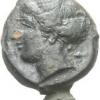
King John Inviato 15 Ottobre, 2018 Autore #2326 Inviato 15 Ottobre, 2018 Bertolami Fine Arts, Auction 6, lot 358, 10/12/2012 Sicily, Bronze,Lipara, After 252 BC, AE, (g 3,82, mm 17, h 2). Male head r.; at l. tongs, Rv. ?I?APAION, Hephaistos standing l., holding spear and tongs. CNS I, n. 36; SNG ANS -.Very rare. Green patina. About extremely fine. 1 Cita Awards
King John Inviato 15 Ottobre, 2018 Autore #2327 Inviato 15 Ottobre, 2018 Heritage Auctions, Auction 2009 january, lot 20075 ROMAN EMPIRE. Hadrian, A.D. 117-138. AR Medallion (24.11g.) with a portrait by the 'Alphaeus Master'. Rome, c. A.D. 135-137. Choice Extremely Fine, lightly porous patina; some encrustation and scratches on the reverse.Obv: HADRIANVS AVGVSTVS. Bust r. of Hadrian, draped and bare-headed, his right shoulder seen slightly from behind, and a scepter is shown over his left shoulder.Rev: COS III (in exergue). At left, Poseidon stands r., his left foot on a rock, holding a trident upright in his right hand and resting upon his knee his left arm, hand extended; behind him a rocky outcrop upon which a dolphin rests, nose down and tail upward. At right, Athena stands l., resting her left hand on her hip, and placing her right hand on a branch of an olive tree, against which she rests her spear; her shield (seen from the interior) is set upright behind her; a snake coils from the base of the tree, its body writhing upward behind Athena and re-emerging between Athena and her shield. Choice XF, lightly porous patina, some encrustation and scratches on the reverse.Commentary: The Rome mint rarely produced silver medallions before the 3rd Century A.D., and this example of Hadrian (perhaps the equivalent of 8 Denarii) may be unique. Far more significant, however, is the quality of its engraving, for the portrait can be attributed with confidence to the 'Alphaeus Master', the most renowned die engraver of the Roman period.The 'Alphaeus Master' likely was a member of Hadrian's inner circle, and he may, in fact, have been the sculptor Antonianus (Antoninianus) of Aphrodisias, whose style epitomized the Hadrianic revival of Greek classicism. His body of work was recognized by Charles Seltman, and can be seen not only on this silver medallion, but on bronze medallions of Hadrian (Gnecchi pl. 39, 3 and pl. 42, 3-4), medallic sestertii of Hadrian (see Sotheby's, 1990, Hunt Sale I, lot 134), and provincial bronze medallions honoring the emperor's companion Antinoüs.The portrait style, inscriptions, and symbolism of this medallion suggest it was struck late in Hadrian's reign, probably for his vicennalian (20th anniversary) celebrations. By this time, Hadrian's infatuation with Greek culture was so complete that it had given rise to a belief that he was an incarnation of Zeus (Jupiter). As testament to his delusion of divine kinship, the obverse shows Hadrian with a scepter over his left shoulder.The reverse speaks of Hadrian's patronage of the Greeks - specifically his love for Athens, the epicenter of Greek civilization and his favorite city. Poseidon (Neptune) and Athena (Minerva) are shown competing to become the patron of Athens. In the competition, both were asked to produce gifts. Poseidon's gift of a spring failed to impress when the spring issued saltwater, but Athena's gift of a sacred olive tree growing on the Acropolis was well received. Athena was judged the winner and was adopted as the patron goddess of the city, which thereafter assumed her name.The scene on this medallion probably is based upon a sculptural group or bas relief monument of the artist Alkamenes. His 'peaceful' version of this mythological episode was passed over in favor of a violent depiction that came to adorn the west pediment of the Parthenon. Alkamenes' version, which shows a calm Poseidon trying to converse with a reflective Athena, was not lost however, for Pausanius tells us it earned a place of honor on the Acropolis.A direct parallel to this scene is found on a sardonyx cameo gem engraved c. 40-30 B.C. which now resides in the collection of the National Archeological Museum in Naples. The fact that it was carved more than 150 years earlier suggests its prototype had been familiar to Romans for centuries before this medallion was struck.Dies with this scene were also used by Hadrian for medallic bronzes struck using portrait dies of regular-issue sestertii (Gnecchi pl. 146, nos. 8 and 9). Variants of the scene appear on medallions of Marcus Aurelius (as Caesar?), and later still on bronzes produced for the Athenians during the 2nd and 3rd Centuries A.D.Accompanied by NGC photo proofs.References:Imhoof-Blumer, F. and Percy Gardner. 1887. A Numismatic Commentary On Pausanius. London: Richard Clay and Sons.Lorber, C. 1983. Numismatic text in Wealth of the Ancient World: The Nelson Bunker Hunt and William Herbert Hunt Collections. Fort Worth, TX: Kimbell Art Museum.Toynbee, J. M. C. 1986. Roman Medallions. American Numismatic Society Numismatic Studies No. 5. New York: American Numismatic Society.From the Deb-Ann Collection. Estimate: 150000.00-200000.00 USD ILLUSTRAZIONE: LA CONTESA TRA POSEIDONE E ATENA PER IL DOMINIO DELL’ATTICA, CAMMEO DEL I SECOLO A.C. (MUSEO NAZIONALE DI NAPOLI) Il Fato aveva predetto che l’Attica sarebbe diventata la regione più forte ricca e importante di tutta la Grecia e così gli dei decisero di insediarsi nelle città, dove ognuno di loro avrebbe avuto il suo culto personale. Poseidone per primo si recò in Attica, vibrò un colpo di tridente in mezzo all’Acropoli e fece apparire una fonte di acqua salata. Dopo di lui venne Atena che piantò un ulivo simbolo di pace e fertilità. Scoppiò una contesa perché nessuno dei due dei voleva cedere la città all'altro e Zeus, che non era riuscito a riconciliarli, decretò che la scelta del dio protettore spettasse ad un tribunale composto da tutte le divinità olimpiche. Poseidone e Atena si presentarono dunque davanti al tribunale divino, Zeus non espresse parere, ma mentre tutti gli dei maschi appoggiavano Poseidone, le dee si schierarono dalla parte di Atena. Così per un voto di maggioranza, Atena ottenne di governare sull'Attica poiché aveva fatto a quella terra il dono migliore: la pace. Poseidone, furibondo, inviò un’inondazione che ricoprì la pianura. Il racconto della disputa rappresenta la giustificazione mitologica del dominio di Atena sulla capitale dell’Attica, ma sottolinea anche l’importanza che fin dall’origine ebbe l’ulivo nell’economia di questa terra. 1 Cita Awards
King John Inviato 15 Ottobre, 2018 Autore #2328 Inviato 15 Ottobre, 2018 (modificato) Classical Numismatic Group > Electronic Auction 420 Auction date: 9 May 2018 Lot number: 441 Price realized: 800 USD (Approx. 675 EUR) Note: Prices do not include buyer's fees. The Triumvirs. Octavian. Autumn 30-summer 29 BC. AR Denarius (16.8mm, 3.99 g, 9h). Italian (Rome?) mint. Laureate head of Octavian, as Apollo, right / Rostral column ornamented with two anchors and six beaks of galleys, surmounted by a statue of Octavian, holding spear and parazonium. CRI 423; RIC I 271; RSC 124 (Augustus). Good VF, toned, light scratches. From the Andrew McCabe Collection. Ex Ernst Ploil Collection (Part III, Numismatica Ars Classica 101, 24 October 2017), lot 51; Lanz 132 (27 November 2006), lot 320. Estimate: 500 USD ILLUSTRAZIONE: la Colonna Duilia (in latino Columna Rostrata C. Duilii, ovvero: Colonna rostrata di Gaio Duilio), un’antica colonna rostrale che si trovava nel Foro Romano. Si trovava accanto ai Rostra imperiali, pur essendo molto più antica, verso il Volcanale. Era stata eretta durante il trionfo del generale Caio Duilio, primo trionfatore romano in una battaglia navale (nella battaglia di Milazzo contro i Cartaginesi nel 260 a.C.), ed era costruita con i rostri delle navi nemiche (da cui derivò lo stesso nome della tribuna dei Rostri). La base della colonna venne rifatta all'epoca di Augusto, copiando esattamente l'antica iscrizione. Dispersa la colonna, la base venne rinvenuta nel XVI secolo presso l'arco di Settimio Severo, nella collocazione originaria. Oggi si trova nel Museo Nuovo Capitolino. Modificato 16 Ottobre, 2018 da King John Cita Awards
King John Inviato 16 Ottobre, 2018 Autore #2329 Inviato 16 Ottobre, 2018 Martí Hervera & Soler y Llach, Subasta 86, lot 50, 30/04/2015 CELTIBERIAN COINS Denario. BOLSCAN. Anv.: Cabeza barbada a derecha, detrás letras ibérica BoN. Rev.: Jinete con lanza a derecha, debajo leyenda ibérica. 4,06 grs. AB-1912. MBC+. ILLUSTRAZIONE: GUERRIERO CELTIBERO Cita Awards
King John Inviato 16 Ottobre, 2018 Autore #2330 Inviato 16 Ottobre, 2018 Roma Numismatics Limited, Auction 11, lot 529, 7/04/2016 Gordian III Æ23 of Seleucia ad Calycadnum, Cilicia. AD 238-244. ΑΝΤΩΝΙΟΣ ΓΟΡΔΙΑΝΟΣ ΣΕΒΑΣ, laureate, draped and cuirassed bust right / ΣΕΛΕΥΚΕΩΝ ΤΩ ΠΡΟ ΠΟ [...], Europa, with veil billowing over her head, seated facing on bull charging to right, dolphin swimming right on waves below. SNG Levante -; SNG France -; SNG von Aulock 5843. 6.26g, 23mm, 12h. Fine patina, Near Extremely Fine. Very Rare Cita Awards
King John Inviato 16 Ottobre, 2018 Autore #2331 Inviato 16 Ottobre, 2018 Classical Numismatic Group, Auction 97, lot 568, 17/09/2014 EGYPT, Alexandria. Trajan. AD 98-117. Æ Drachm (34mm, 22.38 g, 12h). Dated RY 13 (AD 109/110). Laureate bust right, with aegis / Hapi seated slightly left on rocks, draped from the waist down, his right hand raised above his head (indicating that he is asleep), left arm at his side; to right, an inclined Nilometer marked with a graduated scale; above the Nilometer, a hawk (Horus) standing left on a wreathed column or table; to left, a neck amphora on a table (or tripod), [L] IΓ (date) between the table’s legs. Köln –; Dattari (Savio) 960 (this coin) = K&G 27.253 = Emmett 554; cf. E. Christiansen, The Roman Coins of Alexandria , Vol. I, p. 162, where he cites Mionnet VI nos. 627 and 634, and an example in the Thorvaldsen’s Museum collection in Copenhagen; Mionnet VI 634 is probably the same type as this coin, but 627 is not. Fine, attractive even brown patina with touches of green, some very minor porosity. Extremely rare, only three specimens traced including this coin. Ex Künker Auction 226 (11 March 2013), lot 822; Dattari Collection, 960. One of the most fascinating reverse types on an Alexandrian drachm that this cataloguer has ever seen. The reverse depicts a lesser-known god, in the Greco-Roman world, of the Nile – Hapi. Hapi was the god of the annual flooding of the Nile in ancient Egyptian religion. The flood deposited rich silt on the river's banks, allowing the Egyptians to grow their crops each year. Hapi is typically depicted as a man with a large belly wearing a loincloth, and having female-like breasts. “The annual flooding of the Nile occasionally was said to be the Arrival of Hapi . Since this flooding provided fertile soil in an area that was otherwise desert, Hapi, as its patron, symbolized fertility. Due to his fertile nature, he was sometimes considered the ‘father of the gods,’ and was considered to be a caring father who helped to maintain the balance of the cosmos, the world or universe regarded as an orderly, harmonious system. He was thought to live within a cavern at the supposed source of the Nile near Aswan. The cult of Hapi was mainly located at the First Cataract named Elephantine. His priests were involved in rituals to ensure the steady levels of flow required from the annual flood. At Elephantine, the official Nilometer, a measuring device, was carefully monitored to predict the level of the flood, and his priests must have been intimately concerned with its monitoring.” [Source: Wikipedia] The reverse of this extremely rare coin depicts perfectly the mythological role of Hapi and his importance to the Nile and the Egyptian people. ILLUSTRAZIONE: il dio egiziano del Nilo, Hapi, raffigurato nel tempio di Kom Ombo in forma completamente umana, nel succinto abito di strisce di papiro dei barcaioli e dei pescatori. Come dio da cui dipende la produzione agricola, è pingue tanto che si è potuto pensare fosse rappresentato androgino. È spesso figurato nei bassorilievi templari, specie di Bassa Epoca, carico delle offerte che distribuisce. Frequentemente in queste scene il dio è raffigurato diverso per ogni provincia dell'Egitto: e si hanno così serie di Nili, che di regola trovano posto nel registro inferiore delle pareti decorate. Sono rare le rappresentazioni a tutto tondo, e non se ne conoscono templi. Cita Awards
King John Inviato 17 Ottobre, 2018 Autore #2332 Inviato 17 Ottobre, 2018 @Matteo91 ti piace??? Roma Numismatics, Auction XVI, lot 330, prezzo realizzato 16.000 GBP Cilicia, Tarsos AR Stater. Circa 440-400 BC. Horseman (Syennesis?) riding to left, wearing kyrbasia, holding lotus flower in right hand and reins in left, bow in bowcase on saddle; Key symbol below horse / Nergal of Tarsos standing to left, holding lotus flower in right hand and spear in left, bow in bowcase and lion skin over shoulder; Tree of Life behind, Aramaic legend 'LNRGL' (to/for Nergal) to left. BMC -; SNG von Aulock -; SNG Copenhagen -; SNG France -; SNG Levante -; Traité -; Casabonne -; MIMAA -; for obv. type cf. SNG France 213 = Casabonne pl. 2, 10; for rev. type cf. MIMAA type D4, pl. V, 7. 10.66g, 20mm, 10h. Extremely Fine. Unique and unpublished; of great numismatic interest. From a private North American collection. 'Syennesis' was the title held by the local Tarsiote dynasts of Cilicia, at least three of whom figured prominently in Near-Eastern history. The first, an independent monarch in his own right, joined with Nebuchadnezzar in mediating between Cyaxares of Media and Alyattes of Lydia in circa 610 BC. The second appears as a vassal of the Achaemenid king Darius I, and whose daughter was married to Pixodaros, son of Maussolos. He was perhaps the same man whom Herodotos mentioned as one of the most distinguished of the subordinate commanders in the fleet of Xerxes I. The last recorded Syennesis participated in the rebellion of Cyrus the Younger against Artaxerxes II as described in detail in Xenophon's Anabasis. The lack of any further mention of this dynasty following the events of Cyrus' rebellion has long been taken as meaning that the syennesis was forcibly retired and a satrapy established in his place; the general and long-held acceptance by numismatists such as J. P. Six, E. Babelon and C. M Kraay of the obverse horseman portraying the Tarsiote syennesis has therefore complicated the dating of such issues (for an in-depth discussion see Casabonne, Le syennésis cilicien et Cyrus : l'apport des sources numismatiques, 1995). Casabonne does not refute the identification of the obverse figure as the syennesis, but he cautions against attempting to identify particular individuals within the series, rather suggesting the type should be considered in a less literal manner, and, viewed as evidence that the "Tarsiote monetary iconography attests to a certain continuity of relations between the central and local powers", he accepts the type as being certainly "charged with political significance". This being the case, and despite the fact that numismatists and historians alike have long seen the Tarsiote coinage as probably struck (at least in part) for the payment of such tribute to the Achaemenid king as is attested in several sources (see, for example Strabo XV.3.21), it should nonetheless be viewed primarily as a civic and not military coinage, regardless of what it may eventually have been used to finance. This is amply demonstrated by the reverse of this remarkable coin, which employs a highly intriguing design. The standing figure wearing a Persian kandys and carrying both bow and spear is named by the inscription as Nergal, the Babylonian-Assyrian god of the hunt, of war, pestilence and death. Cults at Hatra in Mesopotamia and much later, at Palmyra, have shown that Nergal was equated with the Hellenic Herakles, an assimilation probably begun by the Assyrians who seem to have equated Nergal to Melqart (see Jenkins, Two New Tarsos Coins 1973). Mary Boyce (A History of Zoroastrianism: Volume II: Under the Achaemenians pp. 272) notes that the cult of Nergal "appears to have been well established in Tarsus... there would appear to be a deliberate attempt here at religious syncretism of a sort, in the interests of secular power"; the unique addition of what appears to be a lion-skin hanging from behind Nergal would seem to support this notion. However, Seyrig (Cylinder Seals, 1939) in tracing the existence of the cult of Nergal also to Palestine, Syria and Cyprus, renders his appearance at Tarsos less surprising, and his depiction, while helping to bridge the gap between older periods and the Greco-Roman times, may not simply be a casual attempt at religious conflation but may reflect some deeper metaphor. Nergal, apart from being a god of war and death, was also a god of vegetation and rebirth, attributes that the Greeks associated with Kore-Persephone. The manner of Nergal's depiction here - specifically, holding a lotus flower - together with the placement of a sacred tree or 'tree of life' (which had ancient, but now poorly understood significance in Assyrian religion) behind him, may be indicative of the reason for his appearance. While the tree may also potentially have roots in the Epic of Gilgamesh, wherein Etana searches for a 'plant of birth' to provide him with a son, its meaning is less clear than that of the the lotus flower. The lotus appears only sporadically in Greek and near-Eastern mythology, though it has a well attested use in Egyptian art and legend, where it was taken as a symbolic representation of the sun on account of its physical behaviour: it closes at night time and descends into the water, rising and flowering again at dawn, thus also becoming by extension a symbol of the eternal cycle of death and rebirth. A potential interpretation of Nergal in this context could therefore indicate his favour being sought for a transition of some sort, to preside over a death and a rebirth, an ending and a beginning, past and future. 1 Cita Awards
King John Inviato 17 Ottobre, 2018 Autore #2333 Inviato 17 Ottobre, 2018 (modificato) Roma Numismatics Ltd > Auction XVI Auction date: 26 September 2018 Lot number: 329 Price realized: 2,400 GBP (Approx. 3,159 USD / 2,681 EUR) Note: Prices do not include buyer's fees. Lot description: Cilicia, Tarsos AR Stater. Circa 440-400 BC. Horseman (Syennesis?) riding to left, holding lotus flower in right hand and reins in left, bow in bowcase on saddle; Key symbol below horse / Two Persian soldiers, standing vis-a-vis, each holding spear, with bow in bowcase over shoulder; Aramaic legend 'TRZ' between, letters 'L R' before right hand figure. BMC -; SNG von Aulock -; SNG Copenhagen -; SNG France -; SNG Levante -; Traité II, 526, pl. CVI, 6 = Casabonne Type D1, pl. 2, 9 = Hunterian p. 546, 3 and pl. LX, 6; MIMAA -. 10.72g, 22mm, 9h. Extremely Fine. Of the greatest rarity, apparently only the second known example, and the only one in private hands. From the collection of P.R., United Kingdom. Babelon considered the two figures on the reverse of this coin to be "deux rois de Perse", noting that J. P. Six (NumChron 1884, p. 155) identified them as soldiers, but countering this description with the observation that they both wear 'le costume royal'. In fact, as shown on the 'Relief of the Immortals' at the Apadana Palace, Persepolis, their attire may be considered to be generic, and not necessarily indicative of any special status. While probably not simply representing the frontier guards of Syria and Cilicia as suggested by Six, the type likely does hold some military significance. Certainly, the Syrian Gates (the Belen pass) were of great strategic importance, as attested first-hand by both Xenophon and Alexander the Great, however garrison of this natural choke-point would logically fall not to Cilicia whose territory one would have to pass through before reaching the gates, but to the forces of the satrapy beyond. Indeed Xenophon informs us that they were guarded by a garrison of the King's troops. The Cilician Gates (a pass through the Taurus Mountains connecting the low plains of Cilicia to the Anatolian Plateau) which were of no less importance were guarded by the Cilician troops of the Syennesis, local ruler of Cilicia, and could well be represented here, but in this case it is quite an oblique reference. The paucity of surviving specimens suggests that this issue, along with the other related types of the period, was perhaps either a payment for the services of a small group of mercenary Greek soldiers (for the native Cilician troops would not themselves be paid by their overlords) or part of a tribute which was then melted down into bullion again almost in its entirety, leaving only a couple of surviving specimens. Estimate: 3000 GBP Modificato 17 Ottobre, 2018 da King John 1 Cita Awards
Matteo91 Inviato 17 Ottobre, 2018 #2334 Inviato 17 Ottobre, 2018 Molto belle, @King John Queste monete della Cilicia non si vedevano spesso, mentre negli ultimi due/tre anni ne ho notate diverse... 1 Cita Awards
King John Inviato 18 Ottobre, 2018 Autore #2335 Inviato 18 Ottobre, 2018 Nomos AG > Auction 17 Auction date: 26 October 2018 Lot number: 12 LUCANIA. Metapontum. Circa 330-290 BC. Nomos or Didrachm (Silver, 20 mm, 7.82 g, 10 h). Head of Demeter to left, wearing wreath of barley ears and triple-pendant earring. Rev. ΜΕΤΑ Ear of barley with leaf to left; to left, on leaf, amphora; to left, below leaf, ΦΙ. HN III 1588 corr. (Φ instead of ΦΙ). Johnston Class C - (obverse die C11.8-C11.11, reverse die C11.6). Clear and attractive. Nearly extremely fine. From the Vineyard Collection, bought privately from Spinks in June 1998. Estimate: 550 CHF ILLUSTRAZIONE: DEMETRA 1 Cita Awards
dabbene Inviato 18 Ottobre, 2018 #2336 Inviato 18 Ottobre, 2018 Beh qui siamo nella grande moneta, nel grande simbolo, nelle monete da insegnare e divulgare ai giovani ma poi a tutti 1 Cita
King John Inviato 18 Ottobre, 2018 Autore #2337 Inviato 18 Ottobre, 2018 (modificato) Classical Numismatic Group > Electronic Auction 425 Auction date: 25 July 2018 Lot number: 154 Price realized: 3,000 USD (Approx. 2,563 EUR) Note: Prices do not include buyer's fees. PAPHLAGONIA, Amastris. Queen Amastris. Circa 300-285 BC. AR Double Siglos – Stater (19mm, 9.74 g, 1h). Head of Mên right, wearing Phrygian cap adorned with laurel wreath; bow-in-bowcase to left / Aphrodite seated left, holding in extended right hand Eros, who presents wreath; above, facing head of Helios; lotus-tipped scepter to right, propped against throne. Callataÿ, Premier, Group 1A, 4a (D2/R4 – this coin); RG 1; HGC 7, 352. VF, toned, slightly off center on obverse. Very rare, Group 1A stater, 17 noted by Callataÿ, of which 6 are in museum collections, only 1 additional in CoinArchives. From the DSV Collection. Ex Classical Numismatic Group 67 (22 September 2004), lot 629; Peus 347 (23 April 2003), lot 86; New York Sale IV (16 January 2003), lot 131. Amastris, a niece of Darios III of Persia, became a pawn in the complex dynastic quarrels that followed the death of Alexander. She had been given as wife to Alexander's general Krateros, but was dismissed when Krateros arranged a marriage for himself with the daughter of Antipater. Amastris then married Dionysos, tyrant of Herakleia, by whom she had three children before his death in 306 BC. In 302 BC she married Lysimachos of Thrace, who soon acquired a more profitable alliance by wedding Arsinoë, the daughter of Ptolemy I Soter of Egypt. Amastris then retired to the territory of Herakleia, where she founded a new city named after herself. She was not destined to find peace, however; in 288 BC her two covetous sons had her drowned and seized her city for themselves. Estimate: 750 USD ILLUSTRAZIONE: OMAGGIO ALLA REGINA AMASTRI NELLA CITTA' DI AMASRA IN TURCHIA MEDIANTE LA RIPRODUZIONE DI UNA SUA MONETA Amastri era la nipote di Dario III e di Persia. Maritata da Alessandro Magno a Cratero (324 a. C.), poi da questo abbandonata, sposò Dionisio, tiranno di Eraclea del Ponto, quindi, dopo la morte di Dionisio, Lisimaco, dal quale nel 300 fu ripudiata. A. si dedicò quindi al governo di Eraclea ma per contrasti con i suoi figli fu da essi uccisa nel 290 circa. Modificato 18 Ottobre, 2018 da King John Cita Awards
King John Inviato 18 Ottobre, 2018 Autore #2338 Inviato 18 Ottobre, 2018 (modificato) Fritz Rudolf Künker GmbH & Co. KG, Auction 104, lot 515, 27/09/2005 RÖMISCHE MÜNZEN (ROMAN COINS) MÜNZEN DER RÖMISCHEN KAISERZEIT MÜNZEN DER RÖMISCHEN KAISERZEIT Hadrianus, 117-138. Æ-Drachme, Jahr 18 (= 133/134), Alexandria (Aegyptus); 22.04 g. Kopf l.//Tutu schreitet r. mit Nemeskopftuch und Schutikrone, aus der Brust herausragendem Krokodilskopf und Kobra als Schwanz, auf dem Rücken geflügelter Greif mit Vorderpranke auf Rad. Dattari/Savio Pl. 98, 7911 (dies Exemplar?); Geissen -, vergl. 1131 ff. (Tutu dort irrtümlich als Sphinx beschrieben). RR Gering erhalten/sehr schön Der Gott Tutu, der eindeutig auf dem Revers unseres Stückes dargestellt ist, war der "Oberste des Geschlechtes der Sachmet" und wurde verehrt, um übellaunige Mächte zu besänftigen. Schätzpreis: 100.00 EUR ILLUSTRAZIONE: GLI DEI EGIZI Modificato 18 Ottobre, 2018 da King John Cita Awards
King John Inviato 19 Ottobre, 2018 Autore #2339 Inviato 19 Ottobre, 2018 Roma Numismatics Ltd > Auction XVI Auction date: 26 September 2018 Lot number: 202 Price realized: 16,000 GBP (Approx. 21,061 USD / 17,870 EUR) Note: Prices do not include buyer's fees. Lot description: Macedon, Akanthos AR Tetradrachm. Circa 470-430 BC. Lion to right, attacking bull crouching to left with head half-facing; in exergue, tunny fish to left / AKANΘION in shallow incuse around quadripartite square, the quarters raised and granulated. Cf. Desneux 95, 97-8, 102 (unlisted dies); AMNG III/2, 21; SNG ANS -. 17.14g, 30mm, 3h. Extremely Fine; lustrous metal. Very Rare; engraved in magnificent high classical style. From the Maurice Lucas Collection; Acquired from Numismatic Fine Arts (Beverly Hills) via private treaty, 1989. The ubiquitous and persistent theme of the lion-bull combat can be traced back to the figurate art of the third millennium, where the geometrical motifs are replaced by narrative symbolic representations, and the scene is characteristic of Near Eastern art in its infancy. The earliest known depiction occurs on a ewer found at Uruk dated to the latter part of the Protoliterate period, circa 3300 BC. That ewer has a relief depiction of a lion attacking a bull from behind (see Henri Frankfort, Art and Architecture of the Ancient Orient, 1963). The scene became widely distributed by 500 BC, featuring prominently in the Achaemenid Empire, and in particular at the palace of Darios in Persepolis, where it occurs no fewer than twenty seven times, including on the main staircase leading to the imperial complex. Its frequent appearance in key locations strongly suggests an important symbolic significance, which unfortunately has not survived antiquity in any explicitly clear form. Explanations for the symbolism and its power over the ancient peoples who reproduced it with prodigious enthusiasm have ranged from it being an expression of royal power, to an astronomical allusion, as well as it being an embodiment of the constant struggle between civilisation (represented by the domesticated bull), and nature (represented by the untameable lion). This latter argument may well hold true for the Mesopotamians of Uruk, who it is known took a rather grim view of the world, seeing it as a battleground of opposing powers. One interpretation that has gained traction in recent years is that the motif is apotropaic in nature, serving to ward off evil in a similar function to the gorgoneion, which like the lion attack motif is very prevalent in ancient Greek coinage, though there is little evidence to support such a notion. G. E. Markoe ('The Lion Attack in Archaic Greek Art', Classical Antiquity Vol. 8, 1, 1989) convincingly suggests that a more likely explanation may be found in the examination of archaic Greek epic poetry, particularly in Homeric literature, wherein a lion attacking cattle or sheep is repeatedly employed as a simile for the aggression and valour of combatant heroes. In notable passages, Agamemnon's victorious advance against the Trojans in the Iliad (11.113ff and 129) and Hektor's successful pursuit of the Achaeans (15.630ff) are both likened to a lion triumphing over its hapless prey. In both of these cases the allusion is completed by the defeated being compared to fleeing prey animals. In all, there are twenty five examples present in the Iliad of heroic warriors being compared to leonine aggressors, with the victims variously compared to boars, sheep, goats, bulls or deer. The repetition of this literary device is clearly demonstrative of how deeply rooted the imagery was in the Greek (and perhaps more generally human) consciousness. Of further and great significance is the involvement of the gods as the primary instigators of heroic leonine aggression in almost every case, and as it is made clear that the lion itself is an animal that is divinely directed to its prey (11.480, by a daimon), so then is the lion attack a metaphor for divinely inspired heroic triumph. Estimate: 20000 GBP Cita Awards
King John Inviato 19 Ottobre, 2018 Autore #2340 Inviato 19 Ottobre, 2018 Gorny & Mosch Giessener Münzhandlung > Auction 257 Auction date: 15 October 2018 Lot number: 496 Price realized: Unsold Lot description: PAMPHYLIEN. ASPENDOS. Stater (10,93g). Mitte 5. Jh. v. Chr. Vs.: n. r. auschreitender Krieger mit Schild und Schwert. Rs.: EST, Triskeles. SNG Aul. 4477ff.; SNG BN 2ff. Attraktive Tönung, krakelierte Oberfläche, ss Aus einer ca. 1993 abgeschlossenen Sammlung. Estimate: 900 EUR 1 Cita Awards
King John Inviato 19 Ottobre, 2018 Autore #2341 Inviato 19 Ottobre, 2018 Classical Numismatic Group > Electronic Auction 431 Auction date: 24 October 2018 Lot number: 26 SICILY, Sileraioi. 354/3-344 BC. Æ Litra (28mm, 27.99 g, 2h). Forepart of Acheloios Silaros Himera, as a man-headed bull, left / Warrior advancing right, holding shield and spear. Castrizio Series I, 1; Campana 1; MSP 54; CNS 1; HGC 2, 1242 (this coin illustrated). Near VF, glossy green patina. Rare. Ex Trinacria Collection (Classical Numismatic Group 97, 17 September 2014), lot 37; Classical Numismatic Group 63 (21 May 2003), lot 104. Estimate: 500 USD 1 Cita Awards
King John Inviato 19 Ottobre, 2018 Autore #2342 Inviato 19 Ottobre, 2018 Dr. Busso Peus Nachfolger > Auction 423 Auction date: 7 November 2018 Lot number: 80 Pamphylien (Imitation, van Alfen Typ 4) Aspendos Obol 420/380 v. Chr. Gorgoneion / Kopf der Athena. SNG v. Aulock 4500; SNG BN 28-36. 0.85 g.; Feine Tönung Gutes sehr schön Reinigungskratzer im Revers Ex Auktion Naumann 55, 2017, 343. Estimate: 75 EUR 2 Cita Awards
King John Inviato 19 Ottobre, 2018 Autore #2343 Inviato 19 Ottobre, 2018 Classical Numismatic Group > Electronic Auction 429 Auction date: 26 September 2018 Lot number: 101 Price realized: 50 USD (Approx. 42 EUR) Note: Prices do not include buyer's fees. THESSALY, Pelinna. Late 4th-3rd centuries BC. Æ Dichalkon (19.5mm, 5.12 g, 10h). Veiled head of Mantho right / ΠΕΛΙΝΝΑΙΩΝ, warrior, holding spear, on horse rearing right. Rogers 432; BCD Thessaly II 534.1; HGC 4, 275. VF, green patina. From the BCD Collection. Estimate: 75 USD Cita Awards
King John Inviato 20 Ottobre, 2018 Autore #2344 Inviato 20 Ottobre, 2018 Nomos 4, 10/05/2011, lot 1241 THESSALY, Perrhaiboi. Circa 450-430 BC. Trihemiobol (Silver, 1.39 g 11). Thessalian cavalryman, wearing petasos and chlamys and holding two spears, riding horse walking to left; below, altar. Rev. Π-Ε-Ρ-Α Athena (?), draped, seated to left on high-backed chair, holding crested, Corinthian helmet in both hands. M+M Deutschland 8, 2001, 127 (same dies). Moustaka 46. Rare. An attractive, well preserved and bright coin. Extremely fine. Cita Awards
King John Inviato 20 Ottobre, 2018 Autore #2345 Inviato 20 Ottobre, 2018 Bertolami Fine Arts - ACR Auctions > E-Auction 63 Auction date: 21 October 2018 Lot number: 521 Sicily, Panormos, 2nd century BC. Æ (13.5mm, 4.03g, 10h). Laureate head of Zeus r. R/ Warrior standing l., holding patera and spear, shield at feet. CNS I, 8; HGC 2, 1081. VF Starting Price: 70 GBP Cita Awards
King John Inviato 20 Ottobre, 2018 Autore #2346 Inviato 20 Ottobre, 2018 Hess-Divo AG > Auction 334 Auction date: 29 May 2018 Lot number: 26 Price realized: 80,000 CHF (Approx. 80,410 USD / 69,547 EUR) Note: Prices do not include buyer's fees. Lot description: SICILY. SELINUS. SYRACUSE. Dekadrachm, signed by the master-engraver Euainetos, about 400-390 BC. AR 41.28 g. Fast quadriga l., the charioteer, wearing sleeveless chiton, holds the reins with his l. hand, the kentron in his r. hand; he is crowned by Nike flying r.; in the exergue, panoply of armour: cuirass, greaves, shield and helmet on two steps, below [AΘΛA]. Rev. ΣYΡAKOΣIΩN Head of Kore-Persephone l., crowned with reed, wearing a triple-pendant earring and a necklace; around, four dolphins, below the one under the truncation signature EY-AINE. Gallatin 17, R III/C.IV (these dies); SNG ANS 363. Rare. Masterwork of Sicilian coin-engraving of excellent classical style. Slight traces of earlier cleaning. Extremely fine Provenance: Auction Adolph Hess AG, Lucerne, 14 April 1954, 67. Coins of the artist Euainetos are among the most exquisite works of art from the ancient Greek world. Of special value are his decadrachms, which must have been distributed widely, for they were influential to artists in regions far removed from the shores of Sicily. It is unlikely that many were exported through the normal channels of commerce, and we might suggest that, much like the staters of Olympia, some were acquired as keepsakes and were carried to a variety of destinations. Estimate: 25000 CHF Cita Awards
King John Inviato 20 Ottobre, 2018 Autore #2347 Inviato 20 Ottobre, 2018 Harlan J. Berk, Ltd. > Buy or Bid Sale 206 Auction date: 15 November 2018 Lot number: 72 Attica, Athens. Tetradrachm; Attica, Athens; c. 435 BC, Tetradrachm, 17.14g. Obv: Head of Athena r.; three small upright olive leaves on front edge of Attic helmet; beaded necklace. Rx: Owl standing r., head front; olive twig with two leaves and crescent moon; ethnic in r. field.. EF Buy Price: $1000 Starting Price: 600 USD Cita Awards
King John Inviato 21 Ottobre, 2018 Autore #2348 Inviato 21 Ottobre, 2018 Nomos AG > Auction 17 Auction date: 26 October 2018 Lot number: 154 MYSIA. Kyzikos. Circa 450-330 BC. Stater (Electrum, 16 mm, 16.10 g). Lion crouching to right, biting sword held in his forepaws; below, tunny fish swimming to right. Rev. Quadripartite incuse square. Boston MFA 1502. Greenwell 108. Jameson 2204. SNG BN 322. Von Fritze 177. Toned and boldly struck. Minor marks, otherwise, very fine. Estimate: 20000 CHF Cita Awards
King John Inviato 21 Ottobre, 2018 Autore #2349 Inviato 21 Ottobre, 2018 (modificato) Leu Numismatik AG > Web Auction 5 Auction date: 23 September 2018 Lot number: 551 Price realized: 460 CHF (Approx. 479 USD / 407 EUR) Note: Prices do not include buyer's fees. CILICIA. Tarsus. Hadrian, 117-138. Tridrachm (Silver, 25 mm, 10.13 g, 12 h). ΑΥΤ ΚΑΙ ΘΕ ΤΡΑ ΠΑΡ ΥΙ ΘΕ ΝΕΡ ΥΙ ΤΡΑΙ ΑΔΡΙΑΝΟϹ ϹΕ Laureate head of Hadrian to right, with slight drapery on his left shoulder. Rev. ΤΑΡϹΕΩΝ ΜΗΤΡΟΠΟΛΕΩϹ Sandan, wearing kalathos (?), standing right on a horned lion, wearing on his left side a bowcase and a sword, raising his right hand and holding bipennis and wreath in his left. Prieur 767. RPC III 3266. Slightly rough, otherwise, very fine. Starting Price: 200 CHF Sandan è una divinità pagana, figura centrale del mondo religioso dell'antica Tarso. Fu fu spesso considerato l'omologo di Adone (Siria), di Attis (Frigia) di Osiride (Egitto) e di Tammuz (Babilonia). Era una divinità della terra, ma anche un dio infero che mandava pestilenze. Esistono diversi reperti antichi su cui è raffigurata l'immagine di Sandan. Lo schema iconografico che lo rappresenta è in piedi su un leone dalle lunghe corna, con una ghirlanda in mano, una faretra sulle spalle . Modificato 21 Ottobre, 2018 da King John Cita Awards
King John Inviato 21 Ottobre, 2018 Autore #2350 Inviato 21 Ottobre, 2018 Roma Numismatics Ltd > E-Live Auction 3 Auction date: 25 October 2018 Lot number: 308 Nabataea, Aretas IV, with Shaqilat, Æ15. Petra, AD 16. Aretas standing left, holding spear and resting hand on sword in sheath; palm to left, Aramaic ḥēth to right / Shaqilat standing left, raising hand; [wreath] to left, Shaqilat in Aramaic in three lines to right. Meshorer, Nabataea 97. 2.33g, 15mm, 12h. Very Fine. Estimate: 50 GBP ILLUSTRAZIONE: IL RE DEI NABATEI, ARETAS IV Cita Awards









Risposte migliori
Unisciti alla discussione
Puoi iniziare a scrivere subito, e completare la registrazione in un secondo momento. Se hai già un account, accedi al Forum con il tuo profilo utente..